
Himalayan Stories | Uttarakhand, India
Chausingya Khadu: The Four-Horned Ram of Nanda Devi Raj Jat
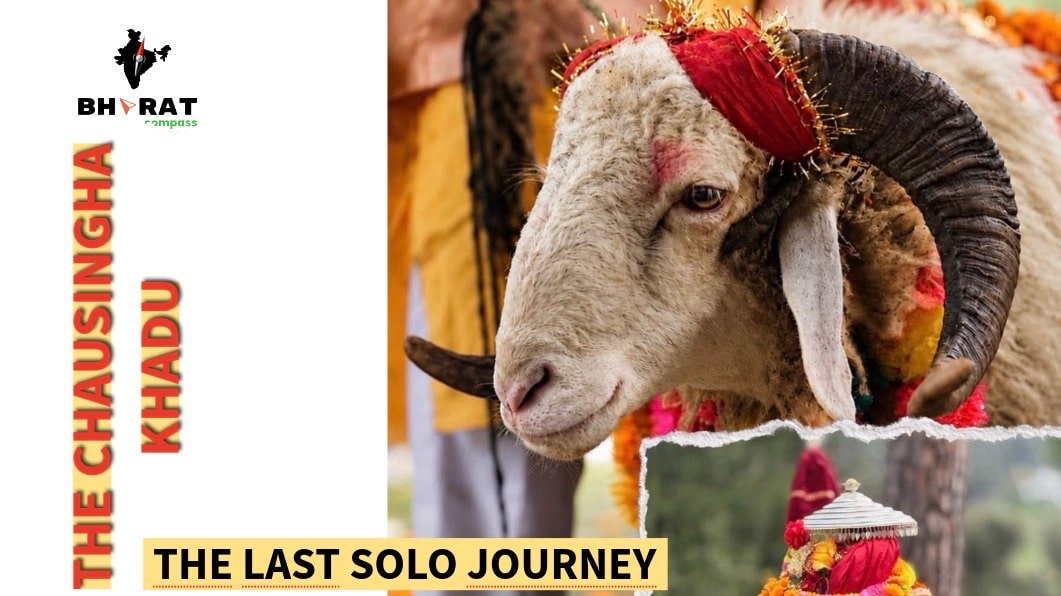
High in the mountains of Uttarakhand, something special happens once every twelve years. Thousands of people walk almost 280 kilometres behind one animal — a rare four-horned ram known as the Chausingya Khadu.
This extraordinary animal leads the famous Nanda Devi Raj Jat (also called Nanda Devi Raj Jaat), one of the most sacred Himalayan pilgrimages. The journey ends at the remote high-altitude site of Homkund, where the four-horned ram is worshipped and released into the wilderness.
What is the Chausingya Khadu?
The story of the Chausingya Khadu begins quietly in a small hill village of Uttarakhand. One day a lamb is born with four distinct horns. For local devotees, this is not just an unusual birth — it is a divine sign that the time for the great Nanda Devi Raj Jat is approaching.
In the local language, “Chausingya” means four-horned and “Khadu” means ram. This rare four-horned ram of Uttarakhand becomes the ceremonial leader of the entire pilgrimage. People believe the Chausingya Khadu is the messenger of Goddess Nanda Devi.
Once chosen, the four-horned ram walks at the front of the procession. Pilgrims follow behind carrying offerings, silk clothes, and prayers from villages across the region. To outsiders it looks like a long mountain trek. To devotees, the Chausingya Khadu is leading Goddess Nanda Devi back to her husband’s home in the high Himalayas.
The Nanda Devi Raj Jat – A Himalayan Farewell
The Nanda Devi Raj Jat (or Nanda Devi Raj Jaat) is much more than a trek. In the culture of Uttarakhand, Goddess Nanda Devi is also a daughter of the mountains. This grand Himalayan pilgrimage is like a farewell procession when a daughter leaves her mother’s home after marriage.
That is why the Nanda Devi Raj Jat feels so emotional. Villagers come out to welcome the procession. Women sing traditional folk songs. Drums beat. People offer food and open their homes to pilgrims walking the Nanda Devi Raj Jat route.
Every village becomes part of this living Himalayan pilgrimage. Songs, meals, prayers, and old stories travel with the four-horned ram and the thousands who follow him.
Where Does the Nanda Devi Raj Jat Route Begin?
The traditional Nanda Devi Raj Jat route starts at Nauti village in Chamoli district of Uttarakhand. Nauti is believed to be the maternal home of Goddess Nanda Devi and remains the most important starting point of this sacred journey.
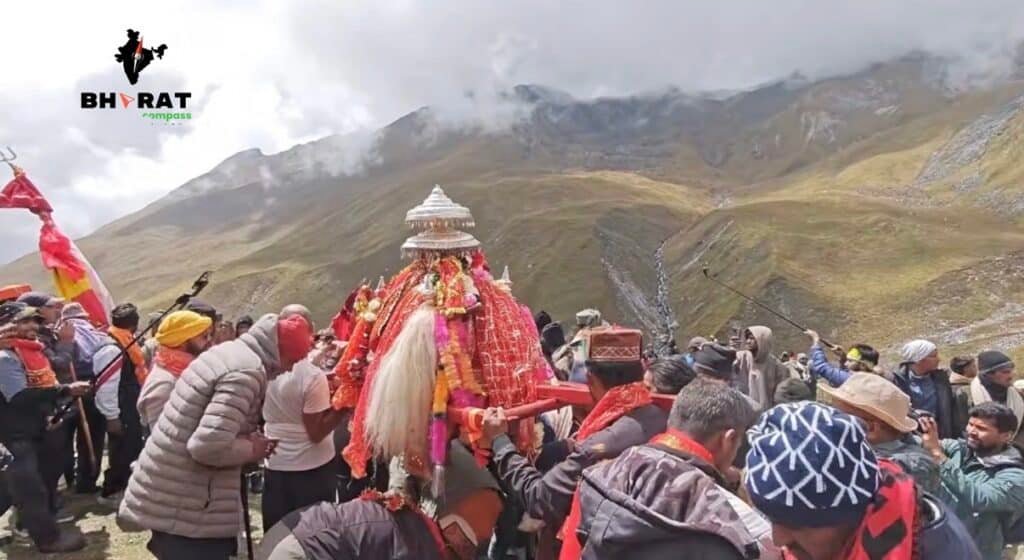
From the lower hills the path climbs steadily higher. Villages give way to forests, forests open into alpine meadows, and finally the green slopes disappear into rock, snow and ice. The full Nanda Devi Raj Jat covers roughly 280 kilometres and usually takes about three weeks.
Main Stops on the Nanda Devi Raj Jat Route
A “padav” is an overnight halt. At every padav the pilgrimage turns into a temporary village filled with food, music, prayers and rest. Here are the main places on the traditional Nanda Devi Raj Jat route:
| Place | Approx. Height | Importance on the Route |
|---|---|---|
| Nauti village | 1,050–1,400 m | Starting point of the Nanda Devi Raj Jat |
| Ida Badhani | 1,200–1,500 m | Early welcome rituals |
| Kansuwa | 1,400–1,600 m | Devotional singing and rest |
| Sem | 1,500–1,700 m | Local prayers and gatherings |
| Koti | 1,600–1,800 m | Traditional music and jagar |
| Bhagoti | 1,700–1,900 m | Village welcome |
| Kulsari | 1,900–2,100 m | Important ritual stop |
| Chepdu–Dewal | 2,000–2,300 m | Leaving the lower valleys |
| Nandkesari | 2,100–2,400 m | Major religious gathering |
| Faldiya Dhar | 2,300–2,600 m | Mountain passage |
| Mundoli | 2,400–2,700 m | Preparation for high altitude |
| Wan Village | 2,400–2,600 m | Gateway to Bedni Bugyal |
| Gairoli Patal | 2,800–3,200 m | Steep forest section |
| Bedni Bugyal | ~3,350 m | Famous alpine meadow |
| Patar Nachauni | 3,800–4,000 m | High and exposed camp |
| Kailwa Vinayak | 4,200 m+ | Steep rocky climb |
| Roopkund (Skeleton Lake) | ~5,000 m | Famous glacial lake region |
| Junargali Pass | Above 5,000 m | One of the hardest sections |
| Shila Samudra | 4,000–4,500 m | Sea of stones near the end |
| Homkund | 4,300–4,800 m | Final destination of the Homkund pilgrimage |
Heights and exact stops on the Nanda Devi Raj Jat route can change because of weather, snow, landslides or local decisions.
From Villages to Bedni Bugyal
In the early days the Nanda Devi Raj Jat route winds through quiet mountain villages of Uttarakhand. Stone houses cling to steep slopes and temple bells echo in the valleys. Pilgrims sleep in community halls, tents or local homes and often receive warm meals from villagers.
After Wan village the landscape becomes more remote. The path climbs through forest and steep terrain before suddenly opening into the vast green expanse of Bedni Bugyal.
At more than 3,300 metres, Bedni Bugyal is one of the most beautiful stops on the entire Nanda Devi Raj Jat. During the pilgrimage this alpine meadow turns into a huge temporary settlement of tents, prayers and traditional music under the open sky.
Towards Roopkund and Junargali Pass
Beyond Bedni Bugyal the Nanda Devi Raj Jat route becomes much harder. The air grows thinner and the trails turn rocky. The procession passes Patar Nachauni and climbs toward Kailwa Vinayak, where wind, fog and sudden weather changes are common.
Further ahead lies the famous Roopkund region, also known as Skeleton Lake because of the ancient human remains found around the glacial lake. Local legends connect these remains with a group of people caught in a sudden storm long ago.
From the Roopkund area the path rises to Junargali Pass, one of the highest and most difficult sections of the Nanda Devi Raj Jat. Steep ground, loose rock and thin air make this part of the Himalayan pilgrimage especially demanding.
Shila Samudra and the Final Approach to Homkund
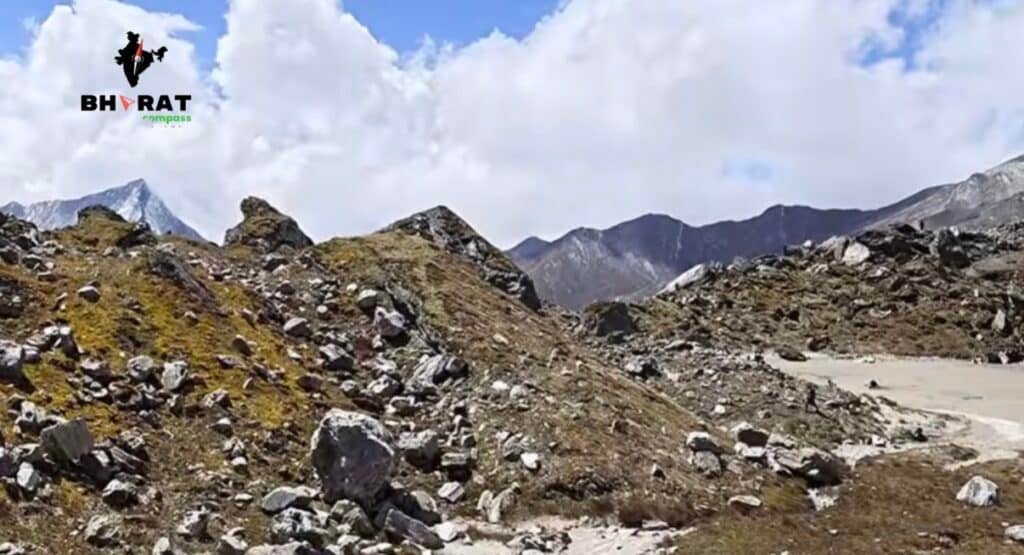
After the high pass the route continues to Shila Samudra — a stark landscape of dark rock and glacial debris that looks like a sea of stones. Trees disappear. The green of the lower hills is only a memory.
By this stage the pilgrims are deep inside a remote high-altitude wilderness. Medical help, communication and facilities are limited. Nature decides every step of the final approach to the Homkund pilgrimage site.
Homkund – The End of the Nanda Devi Raj Jat
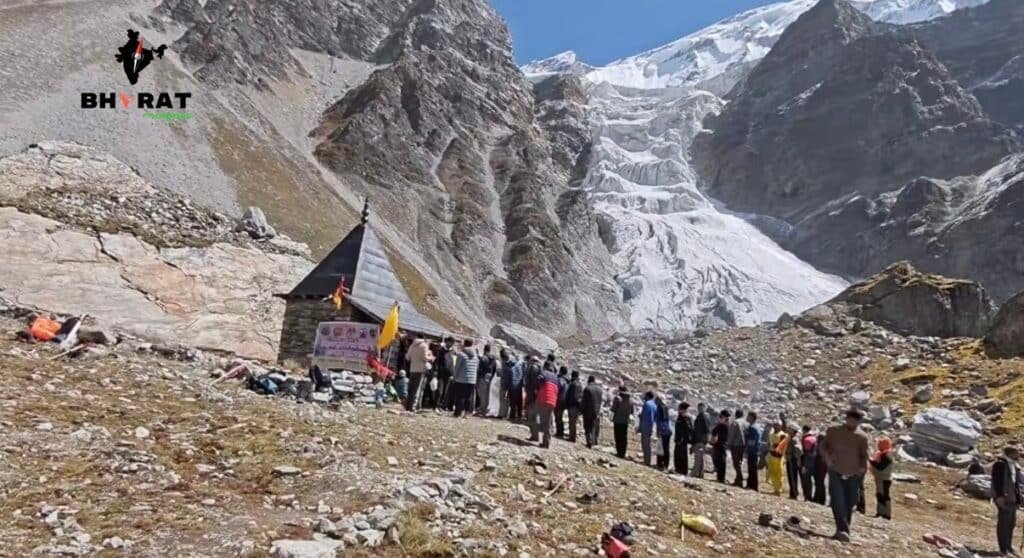
Homkund is the final sacred destination of the Nanda Devi Raj Jat. This remote high-altitude site lies roughly between 4,300 and 4,800 metres. Different accounts give slightly different heights, but everyone agrees it is a wild and powerful place.
The pilgrims do not go beyond Homkund. The mountains ahead are considered the domain of Goddess Nanda Devi and the gateway toward Kailash. At Homkund the Chausingya Khadu is brought to the ceremonial ground. Prayers are offered and sacred items are arranged.
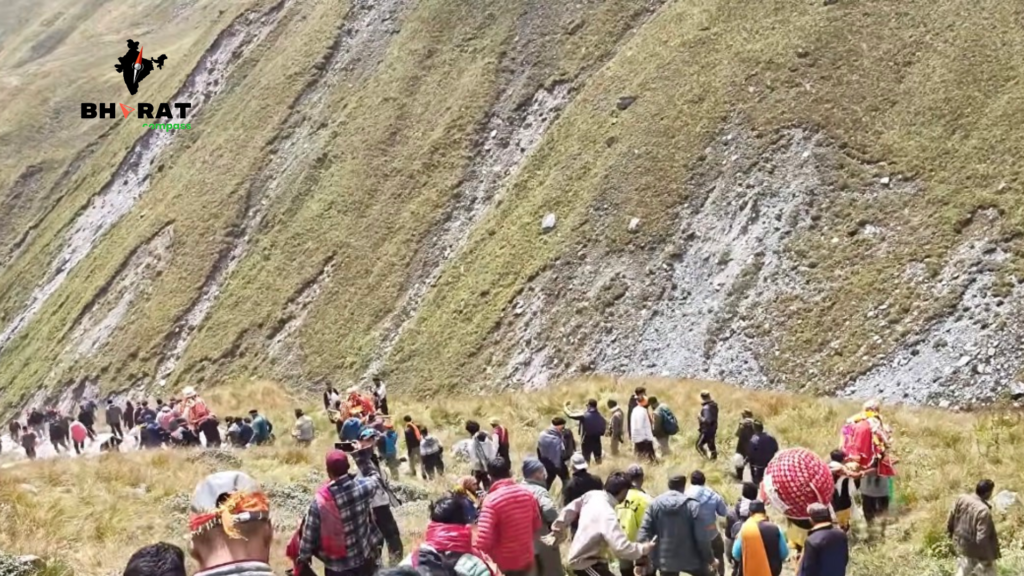
Then comes the most moving moment of the entire Homkund pilgrimage: the four-horned ram is released with the offerings and allowed to walk freely into the high Himalayan wilderness. The people do not follow him. They turn back and begin the long return journey.
What Happens to the Chausingya Khadu After Release?
This is the question everyone asks about the four-horned ram — and no one can fully answer.
Local belief says the Chausingya Khadu carries the prayers of the devotees toward Kailash. He is not brought back to the villages. No one tracks him. After Homkund the ram simply disappears into the wild mountains of Uttarakhand.
There is no verified record of whether the four-horned ram survives the cold, finds a lower valley, or meets a wild animal. The only clear truth is that after the Homkund pilgrimage he is never seen again by human eyes.
For the people of Uttarakhand this mystery is not a problem to solve. It is part of the sacred meaning of the Nanda Devi Raj Jat. The Chausingya Khadu has completed his duty and entered a world where humans are not meant to follow.
After the final worship at Homkund, the Chausingya Khadu is released with sacred offerings into the high Himalayan wilderness. Devotees believe the four-horned ram carries Nanda Devi’s message toward Kailash, while its actual fate remains unknown.
Why the Nanda Devi Raj Jat Matters
The story of the Chausingya Khadu shows how deeply the people of Uttarakhand feel connected to nature. Mountains are sacred. Animals can carry divine messages. Hard journeys become acts of devotion.
The Nanda Devi Raj Jat is also a living cultural archive. Its songs keep local history alive. Its rituals connect distant villages. The Nanda Devi Raj Jat route itself has been walked by mountain communities for generations.
For travellers this Himalayan pilgrimage is extraordinary because it happens only once every twelve years, is led by a rare four-horned ram, and ends with a farewell ritual at Homkund whose final chapter stays a mystery.
Responsible Travel on the Nanda Devi Raj Jat
If you ever get the chance to witness the Nanda Devi Raj Jat or the Homkund pilgrimage, travel with respect. The event belongs first to the local communities and devotees of Uttarakhand.
- Always ask permission before photographing people, rituals or the Chausingya Khadu
- Never touch the four-horned ram or sacred offerings without permission
- Dress modestly near temples and villages
- Follow instructions from local organisers and guides
- Do not litter or make loud noise
- Carry reusable bottles and bring all plastic waste back
- Support local guides and village homestays
- Prepare properly for cold, rain, high altitude and difficult trails on the Nanda Devi Raj Jat route
Frequently Asked Questions
What is the Chausingya Khadu?
The Chausingya Khadu is a rare four-horned ram that leads the Nanda Devi Raj Jat pilgrimage in Uttarakhand. People believe this four-horned ram is the divine messenger of Goddess Nanda Devi.
What is the Nanda Devi Raj Jat?
The Nanda Devi Raj Jat (also called Nanda Devi Raj Jaat) is a major Himalayan pilgrimage dedicated to Goddess Nanda Devi. It takes place once every twelve years and covers about 280 kilometres through the mountains of Chamoli and surrounding areas of Uttarakhand.
Where does the Nanda Devi Raj Jat route begin?
The traditional Nanda Devi Raj Jat route begins at Nauti village in Chamoli district of Uttarakhand, believed to be the maternal home of Goddess Nanda Devi.
Where does the pilgrimage end?
The Nanda Devi Raj Jat ends at Homkund, a remote high-altitude sacred site. The Homkund pilgrimage marks the final ceremonial destination of the journey.
What are the main stops on the route?
Important places on the Nanda Devi Raj Jat route include Nauti village, Kansuwa, Kulsari, Nandkesari, Mundoli, Wan, Gairoli Patal, Bedni Bugyal, Patar Nachauni, Kailwa Vinayak, Roopkund (Skeleton Lake), Junargali Pass, Shila Samudra and Homkund.
What happens to the Chausingya Khadu at Homkund?
At Homkund the four-horned ram is worshipped and then released with sacred offerings into the high Himalayan wilderness. Pilgrims do not follow the Chausingya Khadu beyond this point.
Does the four-horned ram survive after it is released?
There is no verified public record. After the Homkund pilgrimage the Chausingya Khadu disappears from human view. Devotees believe the four-horned ram continues symbolically toward Kailash.
Can foreign tourists join the Nanda Devi Raj Jat?
Foreign visitors may be able to observe or walk permitted sections of this Himalayan pilgrimage, but rules can change. Always check official announcements, travel with experienced local support, and respect all religious and environmental guidelines.
Final Thoughts
The Chausingya Khadu does more than lead a procession. This rare four-horned ram of Uttarakhand carries an entire region’s story of devotion, farewell and mystery along the Nanda Devi Raj Jat route.
From the first prayers at Nauti village to the final silence of Homkund, the Nanda Devi Raj Jat moves through every layer of Himalayan life — villages full of songs, forests, the open beauty of Bedni Bugyal, the legends of Roopkund, and the high wilderness beyond.
At the end the four-horned ram walks into the mountains and vanishes. No one knows where the Chausingya Khadu goes. For the people who walk this sacred Himalayan pilgrimage, that unknown ending is not unfinished.
It is the final act of faith.