
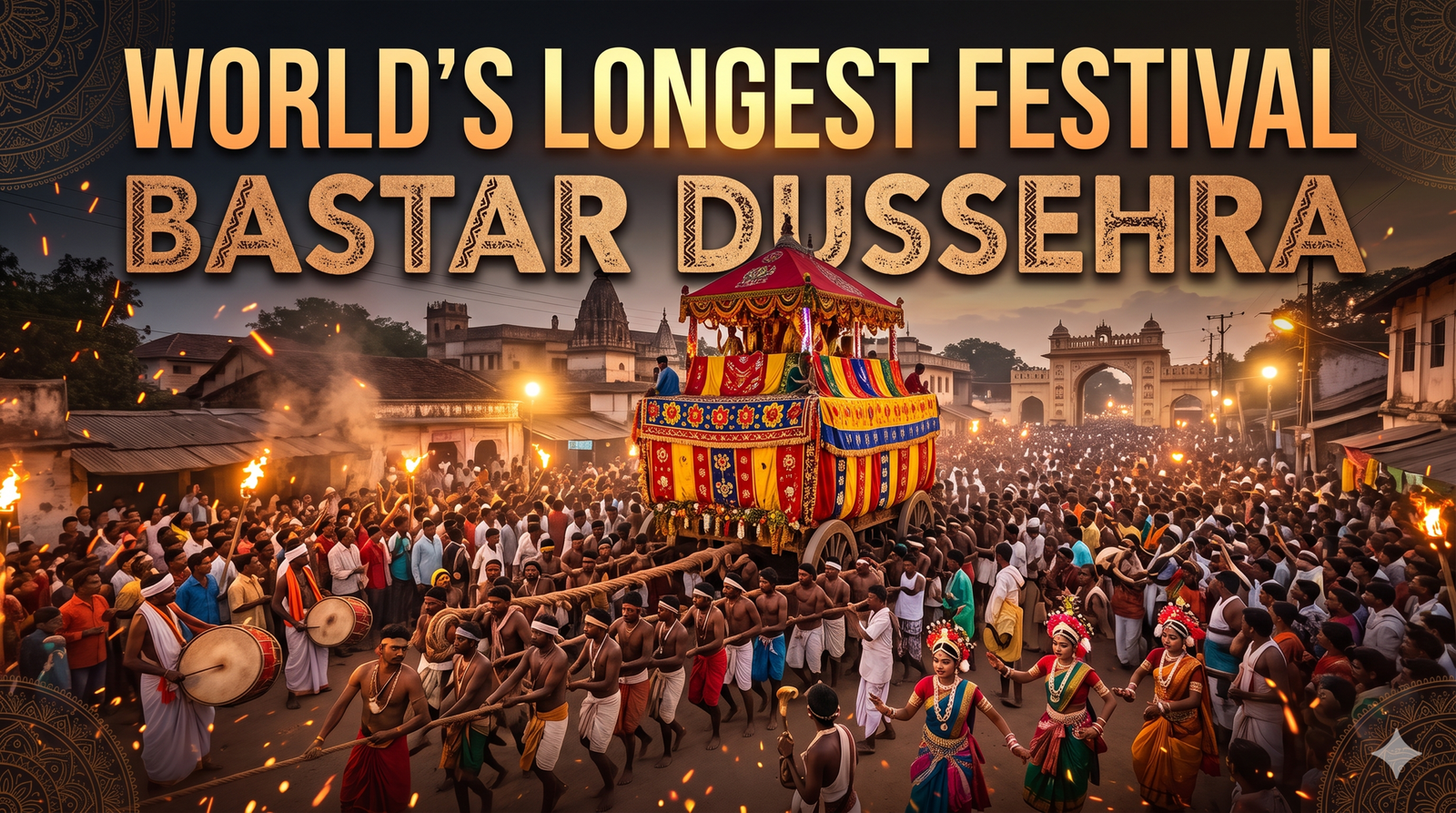
Where is Bastar Dussehra?
Imagine a festival that does not end in a single day or even a week. Imagine one that stretches across the hills and forests for nearly 75 days, drawing people from hundreds of villages into one living celebration of faith. That is Bastar Dussehra—one of India’s most unique and longest-running tribal festivals, celebrated mainly in Jagdalpur, Bastar district, Chhattisgarh.
Unlike the Dussehra most of India knows, this one does not retell the story of Lord Rama and Ravana. Instead, it belongs to Maa Danteshwari, the guardian goddess of Bastar, and to the countless village deities who journey with their people to meet her. Through music, dance, rituals, and processions, the festival becomes a living story of the land, its forests, and the deep bond between the people and their gods.
Where is Bastar Dussehra Located?
Bastar Dussehra Location
The heart of the story beats in Jagdalpur, the main city and administrative centre of Bastar. Here, around the ancient Danteshwari Temple, the old Bastar Palace, the festival grounds, and the winding routes of the grand Bastar Rath Yatra, the rituals unfold year after year.
As the days pass, deities from far-flung villages across the Bastar region begin their journey toward the city. What starts as a local celebration slowly turns into a vast gathering of tribal communities, priests, village heads, artists, and devotees—each carrying their own piece of the story.
Bastar Dussehra State / Province
This festival belongs to the Indian state of Chhattisgarh, a land of dense forests, cascading waterfalls, hidden caves, and vibrant folk traditions. Within this landscape, Bastar stands as the cultural heart—a place where travellers come not just to see, but to feel an older, quieter India still breathing through its people.
Bastar Dussehra District / Region
The story is rooted in the Bastar district. While Jagdalpur hosts the grandest events, the threads of the festival stretch outward to Dantewada, Kondagaon, Narayanpur, Bijapur, and Sukma, each region sending its deities and its people to join the larger celebration.
Bastar Dussehra Country
All of this unfolds in India. Recognised as a major cultural festival of central India, Bastar Dussehra has become an important part of Chhattisgarh’s tourism story—a world-famous religious and cultural event that continues to draw both pilgrims and curious travellers.
Bastar Dussehra Coordinates
If you wish to find the stage of this story on a map, look for Jagdalpur at approximately 19.0948° N latitude and 82.0234° E longitude. Simply searching for “Jagdalpur, Bastar, Chhattisgarh” will lead you there.
About Bastar Dussehra
Bastar Dussehra begins on Hareli Amavasya and slowly builds toward its conclusion on Vijayadashami. Over those roughly 75 days, it becomes a celebration of faith, unity, nature, and tribal identity—woven around the worship of local deities and the forests that have sheltered them for centuries.
At the centre of it all stands the Danteshwari Temple in Jagdalpur. Maa Danteshwari, long regarded as the family deity of the erstwhile royal family of Bastar, remains the guardian goddess of the entire region, watching over every ritual and every devotee who comes.
Why is Bastar Dussehra Famous?
Its fame rests on two rare things: the extraordinary length of nearly 75 days, and the living tribal traditions that still shape every part of it. Few festivals in India gather so many village deities in one place with such ceremony and continuity.
The Bastar Rath Yatra is one of the most powerful moments—hundreds of devotees pulling a massive wooden chariot through the streets of Jagdalpur. Then comes the Muria Durbar, a traditional tribal assembly that still echoes the older systems of governance and community decision-making in Bastar.
What is Bastar Dussehra Known For?
- A festival that lasts approximately 75 days
- Worship of Maa Danteshwari and local village deities
- The grand Bastar Rath Yatra in Jagdalpur
- Muria Durbar, a traditional tribal gathering
- Tribal dance, folk music, rituals, and processions
- Community participation from different Bastar tribes
- A cultural identity completely different from conventional Dussehra celebrations
Bastar Dussehra at a Glance
| Detail | Information |
|---|---|
| Festival Name | Bastar Dussehra |
| Main Location | Jagdalpur, Bastar district, Chhattisgarh |
| Duration | About 75 days |
| Main Deity | Maa Danteshwari |
| Major Events | Paat Jatra, Rath Yatra, Muria Durbar, Mavli Parghav |
| Best Time to Visit | October, especially the final 10 days of the festival |
| Nearest Airport | Swami Vivekananda Airport, Raipur |
| Nearest Railway Station | Jagdalpur Railway Station |
How to Reach Bastar Dussehra
How to Reach Bastar Dussehra by Air
Most journeys begin at Swami Vivekananda Airport in Raipur, about 300 km from Jagdalpur. From there, the road or the rails carry you the rest of the way—by taxi, bus, or train—into the heart of Bastar.
During the final days of the festival, flights into Raipur fill quickly. Those who wish to witness the climax of Bastar Dussehra would do well to book early and leave nothing to chance.
How to Reach Bastar Dussehra by Train
Jagdalpur Railway Station sits right within the city, connected to Raipur and other towns of Chhattisgarh by regular services. For many travellers, the train becomes the most convenient and budget-friendly way to arrive.
Yet tickets disappear fast once the festival nears its peak. Booking early is not just practical—it is often the difference between reaching on time and missing the most powerful moments.
How to Reach Bastar Dussehra by Road
Jagdalpur is well linked by road to Raipur, Bilaspur, Dhamtari, Kondagaon, and other cities. State buses, private coaches, taxis, and self-drive cars all make the journey possible.
The drive from Raipur takes roughly six hours, depending on traffic and weather. Along the way, the landscape itself begins to tell the story—forested stretches, tribal villages, and the quiet sense that you are entering a different world.
Local Transport in Bastar Dussehra
Once in Jagdalpur, autos, shared jeeps, taxis, and local buses move people through the city. During the main events, however, roads near the Rath Yatra route and festival grounds often become crowded or temporarily closed.
Walking then becomes the gentlest way to experience the central areas. For farther destinations—Chitrakote Falls, Tirathgarh Falls, or Kanger Valley National Park—a hired taxi or private vehicle remains the most comfortable choice.
Distance to Bastar Dussehra
Bastar Dussehra Distance from Raipur
Jagdalpur, the main stage of Bastar Dussehra, lies approximately 300 km from Raipur, the capital of Chhattisgarh.
Bastar Dussehra Distance from Nearest Airport
Raipur Airport is about 295 to 300 km from Jagdalpur. After landing, the remaining journey continues by road or train.
Bastar Dussehra Distance from Nearest Railway Station
Jagdalpur Railway Station is the closest railhead and sits within the city itself, making arrival for the festival both simple and convenient.
Travel Time to Bastar Dussehra
- Raipur to Jagdalpur by road: Around 6 hours
- Raipur to Jagdalpur by train: Around 8 to 12 hours, depending on the train
- Raipur Airport to Jagdalpur by taxi: Around 6 to 7 hours
- Jagdalpur city to Chitrakote Falls: Around 1 hour
- Jagdalpur city to Kanger Valley National Park: Around 1 to 1.5 hours
Best Time to Visit Bastar Dussehra
Bastar Dussehra in Summer
From March to June the land grows hot and dry. Daytime temperatures rise sharply, and sightseeing becomes harder. Yet for those who prefer quieter streets and fewer crowds, summer still offers a chance to walk through Bastar’s cultural sites in relative solitude.
Bastar Dussehra in Monsoon
When the rains arrive in June and continue through September, the forests, hills, and waterfalls of Bastar turn lush and dramatic. The beauty is undeniable—but heavy rain can also slow road travel and outdoor plans.
Chitrakote and Tirathgarh Falls look their most spectacular during and just after the monsoon. Travellers who come then should simply check the roads carefully before setting out.
Bastar Dussehra in Winter
Winter, from October to February, is when the story is easiest to enter. Temperatures stay pleasant, usually between 15°C and 30°C, and the days feel open for both festival and exploration. This is the ideal season to witness Bastar Dussehra and to wander the surrounding landscapes.
Peak Season in Bastar Dussehra
The final 10 days of the festival form the peak. The Rath Yatra, the Muria Durbar, the cultural performances, and the main Dussehra celebrations draw the largest crowds then. Hotels, trains, and transport fill early—so those who wish to be present should plan well ahead.
Bastar Dussehra Weather
Bastar Dussehra Weather by Month
| Month | Weather Condition |
|---|---|
| October | Pleasant weather; ideal for Bastar Dussehra |
| November | Cool and dry; excellent for sightseeing |
| December | Winter season; comfortable daytime weather |
| January | Cool nights and pleasant days |
| February | Dry and pleasant weather |
| March to May | Hot summer season |
| June to September | Monsoon season with moderate to heavy rainfall |
Average Temperature in Bastar Dussehra
In the best travel months, average temperatures in Jagdalpur settle between 15°C and 30°C. Nights can turn cooler in winter, while summer afternoons grow sharp and hot.
Rainfall in Bastar Dussehra
Most of the year’s rain falls between June and September. From November to February the skies stay largely clear, offering comfortable conditions for both festival days and outdoor exploration.
Snowfall in Bastar Dussehra
There is no snowfall in Bastar or Jagdalpur. The region carries a tropical to subtropical climate and remains green through much of the year.
Places to Visit in Bastar Dussehra
Best Places to Visit
- Danteshwari Temple, Jagdalpur: The spiritual centre of the festival and the most important temple dedicated to Maa Danteshwari.
- Bastar Palace: A historic reminder of the royal heritage that once shaped the region.
- Anthropological Museum: A quiet place to understand the lives, art, and traditions of Bastar’s tribal communities.
- Dalpat Sagar: A peaceful lake in the city, perfect for a calm evening after the intensity of the festival.
Popular Tourist Attractions
- Chitrakote Falls: About 38 km from Jagdalpur, this wide waterfall on the Indravati River is often called the “Niagara of India.”
- Tirathgarh Falls: A multi-tiered cascade roughly 35 to 38 km away, beautiful and photogenic.
- Kanger Valley National Park: Dense forests, caves, wildlife, and natural beauty waiting just beyond the city.
- Kutumsar Caves: Striking limestone formations near the national park.
Hidden / Less-Visited Places
- Kailash Caves: Quieter rock formations for those who prefer fewer footsteps around them.
- Chitradhara Falls: A gentler waterfall along the route toward Chitrakote.
- Weekly tribal haats: Local markets where the everyday culture of Bastar—handicrafts, food, and village life—comes alive.
Things to Do in Bastar Dussehra
Popular Activities
- Stand among the crowds as the grand Bastar Rath Yatra moves through the streets
- Offer prayers at the Danteshwari Temple
- Witness the traditional Muria Durbar
- Watch tribal dance, folk music, and cultural performances
- Wander through local handicraft markets
- Spend time with local communities and listen to their stories
Adventure Activities
- Take a day trip to Chitrakote Falls
- Explore Kanger Valley National Park
- Visit Tirathgarh Falls
- Step into the limestone caves of Kutumsar and Kailash
- Drive through the forests and pause for nature photography
Family-Friendly Activities
- Spend a relaxed evening by Dalpat Sagar
- Walk through the Anthropological Museum
- Watch cultural programmes during the festival
- Sample local street food and festival stalls
- Visit the safer viewpoints near Chitrakote Falls
Things to Do for Couples
- Watch the sunset near Chitrakote Falls
- Walk quietly around Dalpat Sagar
- Shop for Bastar handicrafts and tribal art together
- Explore local cafes and traditional food spots in Jagdalpur
- Capture photographs as the festival unfolds around you
Bastar Dussehra Itinerary
1-Day Bastar Dussehra Itinerary
- Morning: Visit Danteshwari Temple and Bastar Palace
- Afternoon: Explore the Anthropological Museum and Dalpat Sagar
- Evening: Attend festival celebrations, cultural performances, or Rath Yatra events
2-Day Bastar Dussehra Itinerary
- Day 1: Arrive in Jagdalpur, visit Danteshwari Temple, Bastar Palace, and the Anthropological Museum, then join the evening festival events.
- Day 2: Spend the day at Chitrakote Falls and Chitradhara Falls, returning in time for Rath Yatra or Muria Durbar celebrations.
3-Day Bastar Dussehra Itinerary
- Day 1: Explore Jagdalpur—Danteshwari Temple, Bastar Palace, and the festival atmosphere.
- Day 2: Visit Chitrakote Falls, local markets, and handicraft stalls, then return for evening cultural programmes.
- Day 3: Discover Kanger Valley National Park, Tirathgarh Falls, Kutumsar Caves, and Kailash Caves.
Bastar Dussehra Weekend Itinerary
A weekend is enough for a short but memorable chapter. Arrive Friday night or Saturday morning, spend Saturday among Jagdalpur’s cultural sites and festival events, and devote Sunday to Chitrakote Falls or Kanger Valley National Park before the journey home.
How Many Days Are Enough for Bastar Dussehra?
Two to three days are enough to experience the main celebrations in Jagdalpur and visit one or two nearby attractions.
If you wish to see the Rath Yatra and Muria Durbar, and also explore waterfalls, caves, and the national park without rushing, plan for a three to four-day stay.
Bastar Dussehra Trip Cost
Budget Trip to Bastar Dussehra
A budget journey can be built around simple hotels, local buses, shared jeeps, and street food—ideal for backpackers and solo travellers who want to stay close to the ground.
Mid-Range Trip to Bastar Dussehra
A mid-range plan usually includes a comfortable hotel in Jagdalpur, a private taxi for sightseeing, and visits to Chitrakote Falls, Tirathgarh Falls, and Kanger Valley National Park.
Luxury Trip to Bastar Dussehra
Luxury options are fewer here than in larger tourist destinations. Premium hotels or resorts, private vehicles, and carefully arranged cultural experiences require early booking, especially during the final festival days.
Average Daily Cost
| Travel Style | Average Daily Cost Per Person |
|---|---|
| Budget Trip | ₹1,500 to ₹2,500 |
| Mid-Range Trip | ₹3,000 to ₹6,000 |
| Luxury Trip | ₹7,000 and above |
Where to Stay in Bastar Dussehra
Best Areas to Stay
The most practical place to stay is central Jagdalpur—near the railway station, main market, Danteshwari Temple, or the festival grounds. Being close to the heart of the action saves time and energy on crowded days.
Budget Hotels
Budget hotels, lodges, and guest houses cluster near the bus stand, railway station, and main market. They serve backpackers and thrifty travellers well.
Mid-Range Hotels
Mid-range hotels offer more comfort, parking, and easier access to taxis for day trips beyond the city.
Luxury Hotels
True luxury stays remain limited in Bastar. Those seeking them should book as early as possible once the festival dates approach.
Best Area for Families
Families are best placed in central Jagdalpur near the main market or railway station, where food, transport, medical help, and festival venues stay within easier reach.
Food in Bastar Dussehra
Famous Food in Bastar Dussehra
The food of Bastar is simple, earthy, and closely tied to the forests and tribal kitchens. During the festival, local stalls and traditional eateries grow busier, offering visitors a direct taste of the region’s everyday and ceremonial cooking.
Local Dishes to Try
- Traditional rice-based dishes
- Bamboo shoot preparations
- Local tribal chutneys
- Mahua-based traditional preparations
- Leaf and seed chutneys of the region
- Festival snacks such as pakoras and bhajiyas
Best Areas for Food
The richest places to eat are the main market of Jagdalpur, the areas around the bus stand and railway station, and the temporary food stalls that appear near the festival grounds.
Shopping in Bastar Dussehra
What to Buy
Bastar is known for its tribal handicrafts and traditional art. Dhokra bell-metal work, wooden carvings, terracotta pieces, bamboo crafts, and handwoven textiles all carry the spirit of the place home with you.
Famous Markets
- Jagdalpur main market
- Weekly tribal haats
- Handicraft stalls near festival venues
- Government and cooperative emporiums
Local Souvenirs
- Dhokra metal figurines
- Bell-metal lamps
- Wooden tribal art
- Bamboo products
- Terracotta pottery
- Traditional Bastar textiles
Places to Visit Near Bastar Dussehra
Chitrakote Falls
About 38 km from Jagdalpur, Chitrakote Falls spreads wide across the Indravati River. After the monsoon it becomes especially powerful—one of the most memorable natural chapters near the festival.
Kanger Valley National Park
Just beyond the city, Kanger Valley National Park offers dense forests, caves, waterfalls, and wildlife. It is a natural counterpoint to the human intensity of the Dussehra celebrations.
Tirathgarh Falls
This multi-tiered waterfall, roughly 35 to 38 km from Jagdalpur, rewards nature lovers and photographers with its layered beauty and quieter atmosphere.
Bastar Dussehra Travel Tips
What to Pack
- Comfortable walking shoes
- Light cotton clothes for the day
- A warm jacket for winter evenings
- Raincoat or umbrella if travelling in monsoon
- Power bank and torch
- Basic medicines and a first-aid kit
- A reusable water bottle
- Cash for local markets and small vendors
Local Transportation Tips
Use autos and shared jeeps for short distances inside Jagdalpur. Hire a private taxi for Chitrakote Falls, Tirathgarh Falls, and Kanger Valley National Park. In the final days of the festival, expect temporary road closures and heavy traffic near the main event areas.
Budget Tips
- Prefer the train to Jagdalpur whenever possible
- Use shared transport for nearby attractions
- Book hotels early for the final 10 days
- Eat at local restaurants and street stalls
- Buy handicrafts directly from tribal artisans or recognised emporiums
Safety Tips
- Keep your phone charged and share your itinerary with family
- Avoid isolated forest areas after dark
- Follow instructions from police and festival authorities
- Keep valuables secure in crowded places
- Respect local customs and sacred rituals
- Ask permission before photographing people or religious ceremonies
Important Things to Know
Bastar Dussehra is not merely a tourist spectacle. It is a living spiritual and community festival. Visitors are guests in a long-standing tradition. Respect the rituals, step lightly around sacred moments, and support local artisans by choosing authentic handicrafts.
What you will witness is the unity of Bastar’s tribal communities and their centuries-old relationship with the forests, the villages, and the deities who still walk among them.
Frequently Asked Questions About Bastar Dussehra
Where is Bastar Dussehra?
Bastar Dussehra is celebrated mainly in Jagdalpur, Bastar district, Chhattisgarh, India.
Which state is Bastar Dussehra in?
It takes place in the state of Chhattisgarh.
How do I reach Bastar Dussehra?
Most travellers reach Raipur first, then continue by train, bus, or taxi to Jagdalpur, which lies about 300 km away.
What is Bastar Dussehra famous for?
It is famous for its nearly 75-day duration, its tribal traditions, the Rath Yatra, the Muria Durbar, and the worship of Maa Danteshwari.
What is the best time to visit Bastar Dussehra?
October to February is ideal. The final 10 days of the festival are the most vibrant and the most crowded.
How many days are enough for Bastar Dussehra?
Two to three days cover the main festival experience. Three to four days allow time for waterfalls, caves, and the national park as well.
Is Bastar Dussehra worth visiting?
Yes. For anyone drawn to tribal culture, ancient rituals, folk music, dance, and authentic Indian festivals, Bastar Dussehra is a journey worth making.