
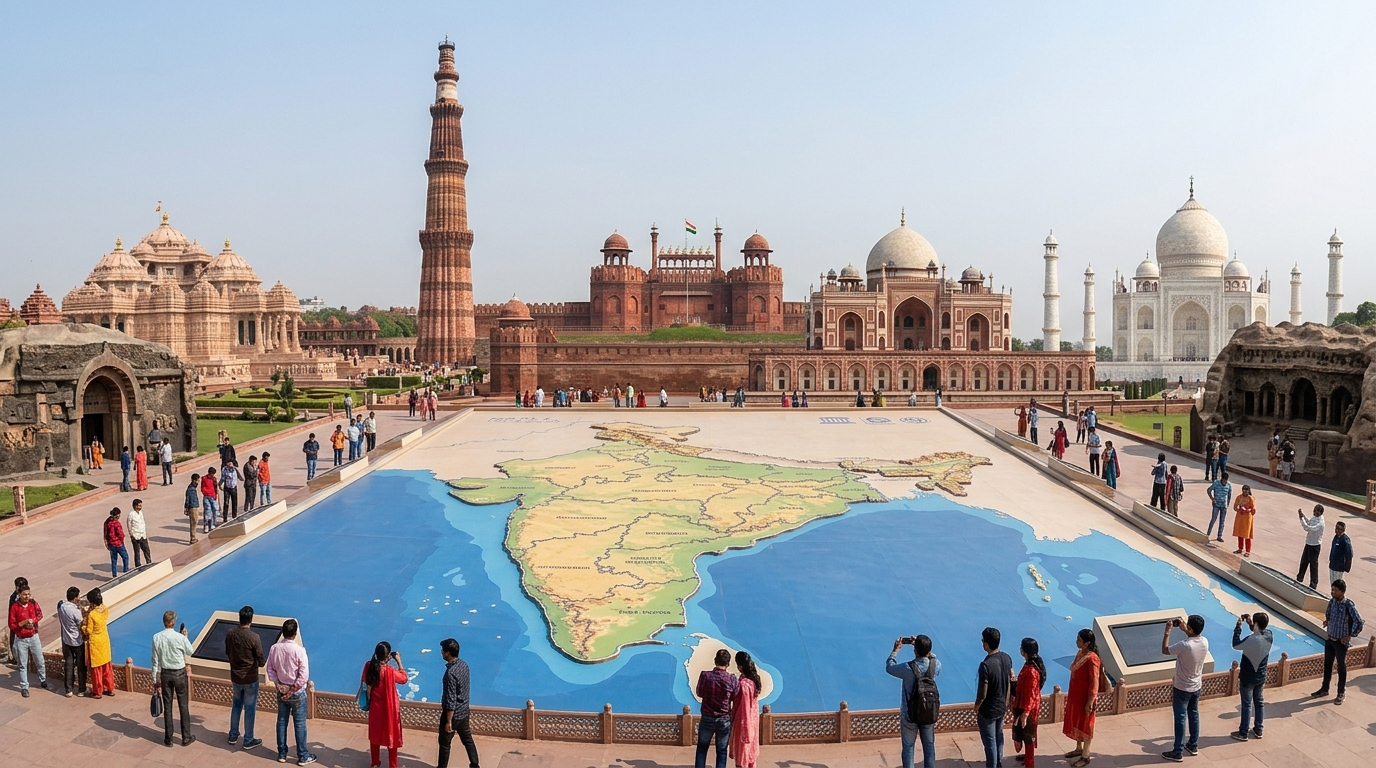
India UNESCO World Heritage Sites & Tentative List 2026
Complete guide to all 45 inscribed UNESCO World Heritage Sites in India plus the four new cultural properties added to the UNESCO Tentative List: the Painted Haveli Towns of Shekhawati, the Colonial Penal Settlement of Andaman Islands, Nicobarese Cultural Continuity in the Central Group of Nicobar Islands, and the Rangpur–Sivasagar Historic Ensemble.
What Is the UNESCO Tentative List?
The UNESCO Tentative List is an inventory of cultural, natural and mixed properties that a country considers suitable for future nomination to the World Heritage List. Inclusion on this list gives a site international recognition, but it does not mean that UNESCO has already granted World Heritage status.
As of October 2026, India has 45 properties inscribed on the World Heritage List (37 cultural, 7 natural, 1 mixed) and 78 sites on the Tentative List. The four newly highlighted Indian properties represent different aspects of heritage: merchant architecture, colonial history, indigenous cultural continuity and the legacy of the Ahom civilisation in Assam.
Important: These four properties should be described as “UNESCO Tentative List sites” or “proposed UNESCO World Heritage sites,” not as confirmed UNESCO World Heritage Sites.
All 45 Inscribed UNESCO World Heritage Sites in India (2026)
India ranks 6th globally with 45 inscribed properties. Below is the complete official list.
Cultural Sites (37)
- Agra Fort (1983, Uttar Pradesh)
- Ajanta Caves (1983, Maharashtra)
- Ellora Caves (1983, Maharashtra)
- Taj Mahal (1983, Uttar Pradesh)
- Group of Monuments at Mahabalipuram (1984, Tamil Nadu)
- Sun Temple, Konârak (1984, Odisha)
- Churches and Convents of Goa (1986, Goa)
- Fatehpur Sikri (1986, Uttar Pradesh)
- Group of Monuments at Hampi (1986, Karnataka)
- Khajuraho Group of Monuments (1986, Madhya Pradesh)
- Elephanta Caves (1987, Maharashtra)
- Great Living Chola Temples (1987/2004, Tamil Nadu)
- Group of Monuments at Pattadakal (1987, Karnataka)
- Buddhist Monuments at Sanchi (1989, Madhya Pradesh)
- Humayun’s Tomb, Delhi (1993)
- Qutb Minar and its Monuments, Delhi (1993)
- Mountain Railways of India (1999/2005/2008)
- Mahabodhi Temple Complex at Bodh Gaya (2002, Bihar)
- Rock Shelters of Bhimbetka (2003, Madhya Pradesh)
- Champaner-Pavagadh Archaeological Park (2004, Gujarat)
- Chhatrapati Shivaji Terminus (2004, Maharashtra)
- Red Fort Complex (2007, Delhi)
- The Jantar Mantar, Jaipur (2010, Rajasthan)
- Hill Forts of Rajasthan (2013)
- Rani-ki-Vav at Patan, Gujarat (2014)
- Archaeological Site of Nalanda Mahavihara (2016, Bihar)
- The Architectural Work of Le Corbusier (Capitol Complex, Chandigarh) (2016)
- Historic City of Ahmadabad (2017, Gujarat)
- Victorian Gothic and Art Deco Ensembles of Mumbai (2018)
- Jaipur City, Rajasthan (2019)
- Dholavira: a Harappan City (2021, Gujarat)
- Kakatiya Rudreshwara (Ramappa) Temple, Telangana (2021)
- Sacred Ensembles of the Hoysalas (2023, Karnataka)
- Santiniketan (2023, West Bengal)
- Moidams – the Mound-Burial System of the Ahom Dynasty (2024, Assam)
- Maratha Military Landscapes of India (2025, Maharashtra & Tamil Nadu)
- Ancient Buddhist Site of Sarnath (2026, Uttar Pradesh)
Natural Sites (7)
- Kaziranga National Park (1985, Assam)
- Keoladeo National Park (1985, Rajasthan)
- Manas Wildlife Sanctuary (1985, Assam)
- Sundarbans National Park (1987, West Bengal)
- Nanda Devi and Valley of Flowers National Parks (1988/2005, Uttarakhand)
- Western Ghats (2012)
- Great Himalayan National Park Conservation Area (2014, Himachal Pradesh)
Mixed Site (1)
- Khangchendzonga National Park (2016, Sikkim)
Where is The Painted Haveli Towns of Shekhawati? Tentative List
Where is The Painted Haveli Towns of Shekhawati Located?
The Painted Haveli Towns of Shekhawati Location
Imagine stepping into an open-air art gallery where every wall tells a story of merchant wealth, mythology and colonial curiosity. That gallery is the Painted Haveli Towns of Shekhawati, a cluster of historic settlements scattered across the semi-arid plains of northern Rajasthan.
The Painted Haveli Towns of Shekhawati State / Province
The Painted Haveli Towns of Shekhawati lie entirely within the state of Rajasthan, India.
The Painted Haveli Towns of Shekhawati District / Region
The heart of the region spreads across the districts of Jhunjhunu, Churu and Sikar in the Shekhawati region of Rajasthan.
The Painted Haveli Towns of Shekhawati Country
The Painted Haveli Towns of Shekhawati are located in India.
The Painted Haveli Towns of Shekhawati Coordinates
Approximate centre of the region: 28° N latitude, 75° E longitude (towns such as Mandawa and Nawalgarh form the practical core).
About The Painted Haveli Towns of Shekhawati
Why is The Painted Haveli Towns of Shekhawati Famous?
Shekhawati is famous because its 18th-, 19th- and early 20th-century merchant mansions – the havelis – are covered floor-to-ceiling in vivid frescoes. Hindu gods share wall space with trains, cars and aeroplanes, turning ordinary towns into living museums of Marwari commercial history.
What is The Painted Haveli Towns of Shekhawati Known For?
It is known for its painted havelis, traditional bazaars, stepwells, cenotaphs and the unique blend of Indian mythology with colonial-era imagery that earned it the nickname “open-air art gallery of Rajasthan.”
The Painted Haveli Towns of Shekhawati at a Glance
- Serial cultural landscape on India’s UNESCO Tentative List
- Main towns: Mandawa, Nawalgarh, Dundlod, Jhunjhunu, Fatehpur, Churu, Ramgarh
- Best experienced as a multi-town road trip
- Ideal for heritage photography, slow travel and cultural immersion
How to Reach The Painted Haveli Towns of Shekhawati
How to Reach The Painted Haveli Towns of Shekhawati by Air
Jaipur International Airport is the most convenient major airport (approximately 150–200 km depending on the town).
How to Reach The Painted Haveli Towns of Shekhawati by Train
Jhunjhunu, Churu, Sikar and Nawalgarh have railway stations with connections from Delhi, Jaipur and other Rajasthan cities.
How to Reach The Painted Haveli Towns of Shekhawati by Road
Excellent road links from Jaipur, Delhi, Bikaner and Chandigarh. A private car or taxi is the most practical way to hop between towns.
Local Transport in The Painted Haveli Towns of Shekhawati
Private taxis, hired cars and occasional local buses. Walking and cycling within each town reveal the best frescoes.
Distance to The Painted Haveli Towns of Shekhawati
The Painted Haveli Towns of Shekhawati Distance from Jaipur
Approximately 150–200 km (3–4 hours by road).
The Painted Haveli Towns of Shekhawati Distance from Nearest Airport
Jaipur International Airport – 150–200 km.
The Painted Haveli Towns of Shekhawati Distance from Nearest Railway Station
Stations at Jhunjhunu, Churu, Sikar and Nawalgarh lie within or very close to the main towns.
Travel Time to The Painted Haveli Towns of Shekhawati
From Jaipur: 3–4 hours by road. From Delhi: 5–7 hours depending on the specific town.
Best Time to Visit The Painted Haveli Towns of Shekhawati
The Painted Haveli Towns of Shekhawati in Summer
Extremely hot; daytime temperatures often exceed 40 °C. Not recommended for walking tours.
The Painted Haveli Towns of Shekhawati in Monsoon
Unpredictable rains can disrupt road travel; landscapes turn green but fresco photography becomes harder.
The Painted Haveli Towns of Shekhawati in Winter
Perfect. Clear skies and comfortable temperatures make October to March the ideal window.
Peak Season in The Painted Haveli Towns of Shekhawati
October to March, with November–February being the most pleasant for multi-day exploration.
The Painted Haveli Towns of Shekhawati Weather
The Painted Haveli Towns of Shekhawati Weather by Month
Cool and dry winters (Oct–Mar); hot, dry summers (Apr–Jun); monsoon influence July–September.
Average Temperature in The Painted Haveli Towns of Shekhawati
Winters: 10–25 °C. Summers: 30–45 °C.
Rainfall in The Painted Haveli Towns of Shekhawati
Low to moderate; concentrated in the monsoon months.
Snowfall in The Painted Haveli Towns of Shekhawati
None – the region is semi-arid and never experiences snow.
Places to Visit in The Painted Haveli Towns of Shekhawati
Best Places to Visit
Mandawa, Nawalgarh, Dundlod, Jhunjhunu, Fatehpur, Churu and Ramgarh – each packed with painted havelis.
Popular Tourist Attractions
Grand havelis with frescoes of mythology and colonial life, traditional bazaars, stepwells, cenotaphs and heritage hotels.
Hidden / Less-Visited Places
Ramgarh’s quieter mansions and the lesser-known painted interiors of Fatehpur and Bissau.
Things to Do in The Painted Haveli Towns of Shekhawati
Popular Activities
Haveli walks, fresco photography, heritage hotel stays, exploring traditional markets.
Adventure Activities
Desert-edge jeep drives and cycling between nearby villages.
Family-Friendly Activities
Guided town walks, light heritage trails and cultural storytelling sessions.
Things to Do for Couples
Sunset photography on quiet lanes, private haveli dinners and heritage hotel stays.
The Painted Haveli Towns of Shekhawati Itinerary
1-Day The Painted Haveli Towns of Shekhawati Itinerary
Base in Mandawa or Nawalgarh; explore 3–4 major havelis and the local market.
2-Day The Painted Haveli Towns of Shekhawati Itinerary
Day 1: Mandawa–Nawalgarh. Day 2: Dundlod–Jhunjhunu.
3-Day The Painted Haveli Towns of Shekhawati Itinerary
Add Fatehpur, Churu and Ramgarh for a fuller circuit.
The Painted Haveli Towns of Shekhawati Weekend Itinerary
Friday evening arrival in Mandawa; full Saturday and Sunday exploring two or three towns before returning to Jaipur.
How Many Days Are Enough for The Painted Haveli Towns of Shekhawati?
Two to three days allow a satisfying multi-town experience; four to five days let you linger and photograph at leisure.
The Painted Haveli Towns of Shekhawati Trip Cost
Budget Trip to The Painted Haveli Towns of Shekhawati
₹2,500–4,000 per person per day (shared transport, simple stays, local food).
Mid-Range Trip to The Painted Haveli Towns of Shekhawati
₹5,000–8,000 per person per day (private car, heritage hotels, guided walks).
Luxury Trip to The Painted Haveli Towns of Shekhawati
₹12,000+ per person per day (boutique heritage properties, private guides).
Average Daily Cost
Around ₹5,000–7,000 for a comfortable mid-range experience.
Where to Stay in The Painted Haveli Towns of Shekhawati
Best Areas to Stay
Mandawa and Nawalgarh offer the highest concentration of heritage hotels.
Budget Hotels
Simple guesthouses and basic heritage stays in all main towns.
Mid-Range Hotels
Restored havelis converted into comfortable hotels.
Luxury Hotels
Grand heritage properties with frescoed courtyards and fine dining.
Best Area for Families
Mandawa – walkable, good facilities and family-friendly heritage hotels.
Food in The Painted Haveli Towns of Shekhawati
Famous Food in The Painted Haveli Towns of Shekhawati
Rajasthani thalis, dal-baati-churma, gatte ki sabzi and local sweets.
Local Dishes to Try
Ker sangri, laal maas (where available), and traditional Marwari vegetarian spreads.
Best Areas for Food
Heritage hotel restaurants and small local eateries in Mandawa and Nawalgarh bazaars.
Shopping in The Painted Haveli Towns of Shekhawati
What to Buy
Hand-block prints, local textiles, miniature paintings and traditional jewellery.
Famous Markets
Town bazaars of Mandawa, Nawalgarh and Jhunjhunu.
Local Souvenirs
Fresco-inspired artworks, embroidered textiles and Rajasthani handicrafts.
Places to Visit Near The Painted Haveli Towns of Shekhawati
Harshnath Temple near Sikar
Ancient hilltop temple with panoramic views.
Khatu Shyam Ji Temple
Popular pilgrimage site a short drive away.
Tal Chhapar Blackbuck Sanctuary
Wildlife interlude amid the heritage circuit.
The Painted Haveli Towns of Shekhawati Travel Tips
What to Pack
Light cotton clothing, comfortable walking shoes, sun protection, camera and a light jacket for winter evenings.
Local Transportation Tips
Hire a private car or taxi for the full multi-town experience; distances between towns are manageable but public transport is limited.
Budget Tips
Stay in restored havelis mid-week, eat local thalis and travel in a small group to share taxi costs.
Safety Tips
Respect private property when photographing; many havelis are still family-owned. Carry water and avoid midday heat.
Important Things to Know
These are UNESCO Tentative List sites – not yet inscribed World Heritage Sites. Plan a road trip rather than a single-town visit.
Frequently Asked Questions About The Painted Haveli Towns of Shekhawati
Where is The Painted Haveli Towns of Shekhawati?
In the Shekhawati region of Rajasthan, mainly across Jhunjhunu, Churu and Sikar districts.
Which state is The Painted Haveli Towns of Shekhawati in?
Rajasthan, India.
How do I reach The Painted Haveli Towns of Shekhawati?
Fly to Jaipur, then drive or take a train to Jhunjhunu/Churu/Sikar; private car is best for inter-town travel.
What is The Painted Haveli Towns of Shekhawati famous for?
Its brilliantly painted merchant havelis – the open-air art gallery of Rajasthan.
What is the best time to visit The Painted Haveli Towns of Shekhawati?
October to March.
How many days are enough for The Painted Haveli Towns of Shekhawati?
2–3 days for a good overview; 4–5 for a relaxed circuit.
Is The Painted Haveli Towns of Shekhawati worth visiting?
Yes – it offers one of India’s most distinctive living heritage experiences and is ideal for a cultural road trip.
Where is Colonial Penal Settlement of Andaman Islands? Tentative List
Where is Colonial Penal Settlement of Andaman Islands Located?
Colonial Penal Settlement of Andaman Islands Location
Far out in the Bay of Bengal, the Colonial Penal Settlement of Andaman Islands is a chain of historic sites that once formed Britain’s remote island prison system after the 1857 uprising.
Colonial Penal Settlement of Andaman Islands State / Province
The settlement lies within the Andaman and Nicobar Islands Union Territory of India.
Colonial Penal Settlement of Andaman Islands District / Region
Primarily around Sri Vijaya Puram (formerly Port Blair) and nearby islands in the Andaman group.
Colonial Penal Settlement of Andaman Islands Country
India.
Colonial Penal Settlement of Andaman Islands Coordinates
Approximate centre (Sri Vijaya Puram): 11.67° N, 92.74° E.
About Colonial Penal Settlement of Andaman Islands
Why is Colonial Penal Settlement of Andaman Islands Famous?
It is famous as the site of Cellular Jail and the wider British penal colony that held political prisoners and freedom fighters under harsh conditions of isolation, forced labour and surveillance.
What is Colonial Penal Settlement of Andaman Islands Known For?
Cellular Jail, Viper Island, Chatham Island and Netaji Subhas Chandra Bose Island (formerly Ross Island) – places that document colonial punishment and India’s freedom struggle.
Colonial Penal Settlement of Andaman Islands at a Glance
- Serial property on India’s UNESCO Tentative List
- Key sites: Cellular Jail, Viper Island, Chatham Island, Netaji Subhas Chandra Bose Island
- Strong association with Indian freedom fighters
- Best combined with a short island history circuit
How to Reach Colonial Penal Settlement of Andaman Islands
How to Reach Colonial Penal Settlement of Andaman Islands by Air
Fly to Veer Savarkar International Airport in Sri Vijaya Puram.
How to Reach Colonial Penal Settlement of Andaman Islands by Train
No direct rail link; fly or take a ship from the mainland.
How to Reach Colonial Penal Settlement of Andaman Islands by Road
Local taxis and autos within Sri Vijaya Puram; boats for the outer islands.
Local Transport in Colonial Penal Settlement of Andaman Islands
Taxis, auto-rickshaws and authorised boat services. Ferry schedules depend on weather and permissions.
Distance to Colonial Penal Settlement of Andaman Islands
Colonial Penal Settlement of Andaman Islands Distance from Major City
Sri Vijaya Puram is the gateway; mainland cities (Chennai, Kolkata, Delhi) are connected by air (2–4 hours flight).
Colonial Penal Settlement of Andaman Islands Distance from Nearest Airport
Veer Savarkar International Airport is within Sri Vijaya Puram itself.
Colonial Penal Settlement of Andaman Islands Distance from Nearest Railway Station
No railway; air or sea only.
Travel Time to Colonial Penal Settlement of Andaman Islands
Flight time from major Indian cities: 2–4 hours. Boat trips to Ross Island and Viper Island: 20–45 minutes depending on conditions.
Best Time to Visit Colonial Penal Settlement of Andaman Islands
Colonial Penal Settlement of Andaman Islands in Summer
Warm and humid; still workable for sightseeing if you start early.
Colonial Penal Settlement of Andaman Islands in Monsoon
Rough seas, possible ferry cancellations and heavy rain – avoid if possible.
Colonial Penal Settlement of Andaman Islands in Winter
Ideal – comfortable temperatures and calmer seas from November to March.
Peak Season in Colonial Penal Settlement of Andaman Islands
October to May, with November–March best for boat trips and outdoor exploration.
Colonial Penal Settlement of Andaman Islands Weather
Colonial Penal Settlement of Andaman Islands Weather by Month
Tropical; dry season roughly October–May, wetter June–September.
Average Temperature in Colonial Penal Settlement of Andaman Islands
25–32 °C year-round.
Rainfall in Colonial Penal Settlement of Andaman Islands
Heavy during monsoon; lighter in the dry season.
Snowfall in Colonial Penal Settlement of Andaman Islands
None.
Places to Visit in Colonial Penal Settlement of Andaman Islands
Best Places to Visit
Cellular Jail, Netaji Subhas Chandra Bose Island (Ross Island), Viper Island and Chatham Island.
Popular Tourist Attractions
Cellular Jail (including the light-and-sound show), colonial ruins on Ross Island, and the historic remains on Viper and Chatham.
Hidden / Less-Visited Places
Chatham Island’s quieter administrative and saw-mill heritage areas.
Things to Do in Colonial Penal Settlement of Andaman Islands
Popular Activities
Guided tours of Cellular Jail, boat trips to Ross and Viper Islands, historical walks.
Adventure Activities
Snorkelling or short island hops (subject to weather and permits).
Family-Friendly Activities
Cellular Jail museum and light-and-sound show, easy boat rides to Ross Island.
Things to Do for Couples
Sunset boat trips and quiet exploration of the colonial ruins.
Colonial Penal Settlement of Andaman Islands Itinerary
1-Day Colonial Penal Settlement of Andaman Islands Itinerary
Morning at Cellular Jail, afternoon boat to Ross Island.
2-Day Colonial Penal Settlement of Andaman Islands Itinerary
Day 1: Cellular Jail + Chatham. Day 2: Ross Island + Viper Island (if open).
3-Day Colonial Penal Settlement of Andaman Islands Itinerary
Add North Bay, Corbyn’s Cove and a museum visit for a fuller historical picture.
Colonial Penal Settlement of Andaman Islands Weekend Itinerary
Arrive Friday, full Saturday and Sunday focused on the four main penal sites and nearby beaches.
How Many Days Are Enough for Colonial Penal Settlement of Andaman Islands?
One to two focused days cover the core sites; three days allow a more relaxed historical circuit.
Colonial Penal Settlement of Andaman Islands Trip Cost
Budget Trip to Colonial Penal Settlement of Andaman Islands
₹3,500–5,500 per person per day.
Mid-Range Trip to Colonial Penal Settlement of Andaman Islands
₹6,000–10,000 per person per day.
Luxury Trip to Colonial Penal Settlement of Andaman Islands
₹15,000+ per person per day.
Average Daily Cost
Around ₹7,000–9,000 for a comfortable mid-range experience.
Where to Stay in Colonial Penal Settlement of Andaman Islands
Best Areas to Stay
Sri Vijaya Puram (Port Blair) for easy access to Cellular Jail and boat jetties.
Budget Hotels
Simple hotels and guesthouses in Sri Vijaya Puram.
Mid-Range Hotels
Comfortable hotels and resorts near the waterfront.
Luxury Hotels
Upscale resorts and heritage-style properties.
Best Area for Families
Central Sri Vijaya Puram — convenient for attractions and transport.
Food in Colonial Penal Settlement of Andaman Islands
Famous Food in Colonial Penal Settlement of Andaman Islands
Fresh seafood, coconut-based curries and South Indian dishes.
Local Dishes to Try
Fish curry, crab preparations and tropical fruit.
Best Areas for Food
Waterfront restaurants and markets in Sri Vijaya Puram.
Shopping in Colonial Penal Settlement of Andaman Islands
What to Buy
Shell crafts, wooden souvenirs and local spices.
Famous Markets
Aberdeen Bazaar and local markets in Sri Vijaya Puram.
Local Souvenirs
Shell jewellery and handcrafted wooden items.
Places to Visit Near Colonial Penal Settlement of Andaman Islands
Corbyn’s Cove Beach
Popular beach close to the main town.
North Bay Island
Snorkelling and water activities.
Chidiya Tapu
Scenic sunset point and birdwatching area.
Colonial Penal Settlement of Andaman Islands Travel Tips
What to Pack
Light cotton clothing, sunscreen, mosquito repellent, comfortable walking shoes and a light rain jacket.
Local Transportation Tips
Book boat trips in advance and keep schedules flexible due to weather.
Budget Tips
Use shared taxis and eat at local seafood spots.
Safety Tips
Follow all boat safety rules and respect restricted zones.
Important Things to Know
This is a UNESCO Tentative List site, not yet an inscribed World Heritage Site. Access to some islands may change with weather or conservation rules.
Frequently Asked Questions About Colonial Penal Settlement of Andaman Islands
Where is Colonial Penal Settlement of Andaman Islands?
In the Andaman Islands, around Sri Vijaya Puram and nearby islands.
Which state is Colonial Penal Settlement of Andaman Islands in?
Andaman and Nicobar Islands Union Territory, India.
How do I reach Colonial Penal Settlement of Andaman Islands?
Fly to Veer Savarkar International Airport in Sri Vijaya Puram; use boats for the outer islands.
What is Colonial Penal Settlement of Andaman Islands famous for?
Cellular Jail and the history of British colonial penal administration linked to India’s freedom struggle.
What is the best time to visit Colonial Penal Settlement of Andaman Islands?
October to May, preferably November–March.
How many days are enough for Colonial Penal Settlement of Andaman Islands?
1–2 days for the core sites; 3 days for a fuller experience.
Is Colonial Penal Settlement of Andaman Islands worth visiting?
Yes — it offers powerful historical insight into India’s freedom struggle in a unique island setting.
Where is Nicobarese Cultural Continuity in the Central Group of Nicobar Islands? Tentative List
Where is Nicobarese Cultural Continuity in the Central Group of Nicobar Islands Located?
Nicobarese Cultural Continuity in the Central Group of Nicobar Islands Location
This is a living cultural landscape centred on the traditional life of Nicobarese communities in the Central Group of the Nicobar Islands.
Nicobarese Cultural Continuity in the Central Group of Nicobar Islands State / Province
Andaman and Nicobar Islands Union Territory, India.
Nicobarese Cultural Continuity in the Central Group of Nicobar Islands District / Region
Central Group / Nancowrie subdivision of Nicobar District (islands including Chowra, Trinket, Bompoka, Kamorta and surrounding areas).
Nicobarese Cultural Continuity in the Central Group of Nicobar Islands Country
India.
Nicobarese Cultural Continuity in the Central Group of Nicobar Islands Coordinates
Approximate centre of the Central Nicobar group: around 8° N, 93° E.
About Nicobarese Cultural Continuity in the Central Group of Nicobar Islands
Why is Nicobarese Cultural Continuity in the Central Group of Nicobar Islands Famous?
It is famous as a living indigenous cultural landscape that shows the continuous relationship between Nicobarese communities, their traditional practices, island ecosystems and ancestral knowledge.
What is Nicobarese Cultural Continuity in the Central Group of Nicobar Islands Known For?
Traditional settlement patterns, environmental knowledge, customary practices and the ongoing bond between people, the sea, forests and islands — heritage based on continuity rather than only monuments.
Nicobarese Cultural Continuity in the Central Group of Nicobar Islands at a Glance
- UNESCO Tentative List living cultural landscape
- Focus on indigenous community life and traditional knowledge
- Highly restricted access
- Not a regular open-tourism destination
How to Reach Nicobarese Cultural Continuity in the Central Group of Nicobar Islands
How to Reach Nicobarese Cultural Continuity in the Central Group of Nicobar Islands by Air
Fly to Veer Savarkar International Airport in Sri Vijaya Puram, then confirm latest permit and onward travel rules.
How to Reach Nicobarese Cultural Continuity in the Central Group of Nicobar Islands by Train
No rail access.
How to Reach Nicobarese Cultural Continuity in the Central Group of Nicobar Islands by Road
No road access from the mainland; sea or authorised air/sea connections only.
Local Transport in Nicobarese Cultural Continuity in the Central Group of Nicobar Islands
Only authorised government or permitted transport. Unauthorised travel is prohibited.
Distance to Nicobarese Cultural Continuity in the Central Group of Nicobar Islands
Nicobarese Cultural Continuity in the Central Group of Nicobar Islands Distance from Major City
Sri Vijaya Puram is the usual gateway; further travel depends on official permissions.
Nicobarese Cultural Continuity in the Central Group of Nicobar Islands Distance from Nearest Airport
Veer Savarkar International Airport (Sri Vijaya Puram), followed by restricted onward travel.
Nicobarese Cultural Continuity in the Central Group of Nicobar Islands Distance from Nearest Railway Station
None.
Travel Time to Nicobarese Cultural Continuity in the Central Group of Nicobar Islands
Highly variable and dependent on permits, weather and official schedules.
Best Time to Visit Nicobarese Cultural Continuity in the Central Group of Nicobar Islands
Nicobarese Cultural Continuity in the Central Group of Nicobar Islands in Summer
Warm and humid; possible if permits allow.
Nicobarese Cultural Continuity in the Central Group of Nicobar Islands in Monsoon
Rough seas and heavy rain — generally unsuitable.
Nicobarese Cultural Continuity in the Central Group of Nicobar Islands in Winter
More suitable weather window (October–May), but still subject to permissions.
Peak Season in Nicobarese Cultural Continuity in the Central Group of Nicobar Islands
Subject to official permission and weather; October–May is generally better for the wider Andaman & Nicobar region.
Nicobarese Cultural Continuity in the Central Group of Nicobar Islands Weather
Nicobarese Cultural Continuity in the Central Group of Nicobar Islands Weather by Month
Tropical island climate; wetter during the monsoon months.
Average Temperature in Nicobarese Cultural Continuity in the Central Group of Nicobar Islands
Typically 25–32 °C.
Rainfall in Nicobarese Cultural Continuity in the Central Group of Nicobar Islands
Significant during the monsoon.
Snowfall in Nicobarese Cultural Continuity in the Central Group of Nicobar Islands
None.
Places to Visit in Nicobarese Cultural Continuity in the Central Group of Nicobar Islands
Best Places to Visit
Only permitted areas within the Central Group under official guidance.
Popular Tourist Attractions
This is not developed as a conventional tourist attraction. Its value lies in living cultural continuity.
Hidden / Less-Visited Places
The entire property is restricted; unauthorised access is not allowed.
Things to Do in Nicobarese Cultural Continuity in the Central Group of Nicobar Islands
Popular Activities
Only activities permitted under official rules and community protection guidelines.
Adventure Activities
Not applicable in the conventional tourist sense.
Family-Friendly Activities
Not a standard family tourism destination.
Things to Do for Couples
Not applicable under open-tourism conditions.
Nicobarese Cultural Continuity in the Central Group of Nicobar Islands Itinerary
1-Day / 2-Day / 3-Day / Weekend Itineraries
Not feasible as open tourism. Any visit requires prior official permission and must follow all restrictions.
How Many Days Are Enough for Nicobarese Cultural Continuity in the Central Group of Nicobar Islands?
Depends entirely on official permissions; most travellers cannot visit freely.
Nicobarese Cultural Continuity in the Central Group of Nicobar Islands Trip Cost
Budget / Mid-Range / Luxury / Average Daily Cost
Highly variable and only relevant for those with official authorisation. Costs include permits, specialised transport and compliance requirements.
Where to Stay in Nicobarese Cultural Continuity in the Central Group of Nicobar Islands
Best Areas / Budget / Mid-Range / Luxury / Families
Accommodation is extremely limited and subject to official rules. Most visitors stay in permitted areas of the Andaman group instead.
Food in Nicobarese Cultural Continuity in the Central Group of Nicobar Islands
Famous Food / Local Dishes / Best Areas
Traditional Nicobarese food is community-based and not part of open tourism infrastructure.
Shopping in Nicobarese Cultural Continuity in the Central Group of Nicobar Islands
What to Buy / Markets / Souvenirs
Not applicable. Unauthorised purchase or collection from restricted communities is prohibited.
Places to Visit Near Nicobarese Cultural Continuity in the Central Group of Nicobar Islands
Sri Vijaya Puram, Ross Island, North Bay, Chidiya Tapu, Havelock Island
These are the accessible alternatives in the wider Andaman Islands for visitors who cannot enter the restricted Nicobar areas.
Nicobarese Cultural Continuity in the Central Group of Nicobar Islands Travel Tips
What to Pack
Only relevant for permitted visitors — follow official advice.
Local Transportation Tips
Only authorised transport.
Budget Tips
Not a conventional tourist destination.
Safety Tips
Never attempt unauthorised travel, photography or contact with protected indigenous communities.
Important Things to Know
Responsible travel warning: Indigenous communities must not be treated as tourist attractions. Follow all permit rules, avoid unauthorised photography and never enter restricted tribal reserves. This is a UNESCO Tentative List living cultural landscape, not an open tourist site.
Frequently Asked Questions About Nicobarese Cultural Continuity in the Central Group of Nicobar Islands
Where is Nicobarese Cultural Continuity in the Central Group of Nicobar Islands?
In the Central Group of the Nicobar Islands, Andaman and Nicobar Islands Union Territory.
Which state is Nicobarese Cultural Continuity in the Central Group of Nicobar Islands in?
Andaman and Nicobar Islands Union Territory, India.
How do I reach Nicobarese Cultural Continuity in the Central Group of Nicobar Islands?
Only with official government permission. Most travellers cannot visit freely.
What is Nicobarese Cultural Continuity in the Central Group of Nicobar Islands famous for?
Living indigenous cultural heritage and the continuous relationship of Nicobarese communities with their island environment.
What is the best time to visit Nicobarese Cultural Continuity in the Central Group of Nicobar Islands?
Subject to permission and weather; October–May is generally better for the region.
How many days are enough for Nicobarese Cultural Continuity in the Central Group of Nicobar Islands?
Depends entirely on official authorisation.
Is Nicobarese Cultural Continuity in the Central Group of Nicobar Islands worth visiting?
It is a significant living heritage landscape, but access is strictly controlled for the protection of indigenous communities and ecosystems.
Where is Rangpur–Sivasagar Historic Ensemble? Tentative List
Where is Rangpur–Sivasagar Historic Ensemble Located?
Rangpur–Sivasagar Historic Ensemble Location
In Upper Assam, the Rangpur–Sivasagar Historic Ensemble preserves the political, architectural and cultural heart of the Ahom kingdom.
Rangpur–Sivasagar Historic Ensemble State / Province
Assam, India.
Rangpur–Sivasagar Historic Ensemble District / Region
Sivasagar district (historically known as Rangpur).
Rangpur–Sivasagar Historic Ensemble Country
India.
Rangpur–Sivasagar Historic Ensemble Coordinates
Approximate centre (Sivasagar): 26.98° N, 94.63° E.
About Rangpur–Sivasagar Historic Ensemble
Why is Rangpur–Sivasagar Historic Ensemble Famous?
It is famous as the former capital region of the Ahom kingdom, which ruled the Brahmaputra Valley for nearly six centuries, leaving behind distinctive royal architecture, temples, tanks and ceremonial landscapes.
What is Rangpur–Sivasagar Historic Ensemble Known For?
Rang Ghar, Talatal Ghar, Kareng Ghar, Siva Dol, Vishnu Dol, Devi Dol, Joysagar and the wider Ahom urban and hydraulic landscape.
Rangpur–Sivasagar Historic Ensemble at a Glance
- UNESCO Tentative List historic cultural ensemble
- Key monuments of the Ahom dynasty
- Complements the already-inscribed Moidams at Charaideo
- Ideal for a focused Assam heritage circuit
How to Reach Rangpur–Sivasagar Historic Ensemble
How to Reach Rangpur–Sivasagar Historic Ensemble by Air
Jorhat Airport is the most convenient; Dibrugarh Airport is an alternative.
How to Reach Rangpur–Sivasagar Historic Ensemble by Train
Sivasagar Town and nearby stations connect with Assam’s railway network.
How to Reach Rangpur–Sivasagar Historic Ensemble by Road
Regular buses and taxis link Sivasagar with Jorhat, Dibrugarh and other Assam towns.
Local Transport in Rangpur–Sivasagar Historic Ensemble
Taxis, autos and local buses; private car is convenient for the monument cluster.
Distance to Rangpur–Sivasagar Historic Ensemble
Rangpur–Sivasagar Historic Ensemble Distance from Major City
Approximately 360 km from Guwahati; closer to Jorhat and Dibrugarh.
Rangpur–Sivasagar Historic Ensemble Distance from Nearest Airport
Jorhat Airport – roughly 55–60 km.
Rangpur–Sivasagar Historic Ensemble Distance from Nearest Railway Station
Sivasagar Town and nearby stations.
Travel Time to Rangpur–Sivasagar Historic Ensemble
From Jorhat: about 1.5–2 hours by road.
Best Time to Visit Rangpur–Sivasagar Historic Ensemble
Rangpur–Sivasagar Historic Ensemble in Summer
Warm and humid.
Rangpur–Sivasagar Historic Ensemble in Monsoon
Heavy rain; can affect road travel, though the landscape becomes lush.
Rangpur–Sivasagar Historic Ensemble in Winter
Most pleasant — October to April, especially November–February.
Peak Season in Rangpur–Sivasagar Historic Ensemble
October to April.
Rangpur–Sivasagar Historic Ensemble Weather
Rangpur–Sivasagar Historic Ensemble Weather by Month
Cooler and drier winters; hot-humid summers; heavy monsoon rains.
Average Temperature in Rangpur–Sivasagar Historic Ensemble
Winters comfortable; summers warm to hot.
Rainfall in Rangpur–Sivasagar Historic Ensemble
Significant during the monsoon months.
Snowfall in Rangpur–Sivasagar Historic Ensemble
None.
Places to Visit in Rangpur–Sivasagar Historic Ensemble
Best Places to Visit
Rang Ghar, Talatal Ghar, Kareng Ghar, Siva Dol, Vishnu Dol, Devi Dol and Joysagar.
Popular Tourist Attractions
Royal pavilions, palace complexes, temples and the large historic tanks.
Hidden / Less-Visited Places
Quieter corners of the tank landscapes and lesser-known Ahom remains.
Things to Do in Rangpur–Sivasagar Historic Ensemble
Popular Activities
Heritage walks, photography of Ahom architecture, visiting the temples and tanks.
Adventure Activities
Limited; the focus is cultural and historical.
Family-Friendly Activities
Exploring the monument cluster and open tank landscapes.
Things to Do for Couples
Quiet heritage walks and sunset views around the tanks.
Rangpur–Sivasagar Historic Ensemble Itinerary
1-Day Rangpur–Sivasagar Historic Ensemble Itinerary
Rang Ghar → Talatal Ghar → Siva Dol and the main tank complex.
2-Day Rangpur–Sivasagar Historic Ensemble Itinerary
Day 1: Core monuments. Day 2: Joysagar and surrounding temples + Charaideo Moidams.
3-Day Rangpur–Sivasagar Historic Ensemble Itinerary
Add Jorhat tea gardens or a longer exploration of Ahom sites.
Rangpur–Sivasagar Historic Ensemble Weekend Itinerary
Arrive via Jorhat; full day on the ensemble + half day at Charaideo.
How Many Days Are Enough for Rangpur–Sivasagar Historic Ensemble?
One full day for the core sites; two days to combine with Charaideo Moidams.
Rangpur–Sivasagar Historic Ensemble Trip Cost
Budget Trip to Rangpur–Sivasagar Historic Ensemble
₹2,500–4,000 per person per day.
Mid-Range Trip to Rangpur–Sivasagar Historic Ensemble
₹5,000–8,000 per person per day.
Luxury Trip to Rangpur–Sivasagar Historic Ensemble
₹10,000+ per person per day.
Average Daily Cost
Around ₹5,000–7,000.
Where to Stay in Rangpur–Sivasagar Historic Ensemble
Best Areas to Stay
Sivasagar town or nearby Jorhat.
Budget Hotels
Simple hotels in Sivasagar.
Mid-Range Hotels
Comfortable hotels and resorts in Sivasagar / Jorhat.
Luxury Hotels
Upscale options mainly in Jorhat or Guwahati for longer stays.
Best Area for Families
Sivasagar town for proximity to the monuments.
Food in Rangpur–Sivasagar Historic Ensemble
Famous Food in Rangpur–Sivasagar Historic Ensemble
Assamese thalis, fish preparations and rice-based dishes.
Local Dishes to Try
Masor tenga, pitika and traditional Assamese vegetarian platters.
Best Areas for Food
Local restaurants in Sivasagar and hotel dining.
Shopping in Rangpur–Sivasagar Historic Ensemble
What to Buy
Assamese silk, traditional textiles and local handicrafts.
Famous Markets
Local markets in Sivasagar.
Local Souvenirs
Gamocha, silk items and regional crafts.
Places to Visit Near Rangpur–Sivasagar Historic Ensemble
Moidams of the Ahom Dynasty at Charaideo
Already an inscribed UNESCO World Heritage Site.
Majuli Island
World’s largest river island with unique cultural heritage.
Jorhat tea gardens
Scenic tea-estate experiences.
Rangpur–Sivasagar Historic Ensemble Travel Tips
What to Pack
Light clothing, comfortable walking shoes, umbrella or rain jacket in monsoon, and mosquito repellent.
Local Transportation Tips
Private car or taxi is convenient for linking the monuments and Charaideo.
Budget Tips
Combine with Charaideo and use local transport where possible.
Safety Tips
Respect religious sites and follow local guidelines at monuments.
Important Things to Know
This is a UNESCO Tentative List site. Pairing it with the inscribed Charaideo Moidams makes an excellent Ahom heritage circuit.
Frequently Asked Questions About Rangpur–Sivasagar Historic Ensemble
Where is Rangpur–Sivasagar Historic Ensemble?
In Sivasagar district, Assam.
Which state is Rangpur–Sivasagar Historic Ensemble in?
Assam, India.
How do I reach Rangpur–Sivasagar Historic Ensemble?
Fly to Jorhat (or Dibrugarh), then drive or take a taxi/bus to Sivasagar.
What is Rangpur–Sivasagar Historic Ensemble famous for?
Ahom royal architecture, temples, tanks and the political-cultural legacy of the Ahom kingdom.
What is the best time to visit Rangpur–Sivasagar Historic Ensemble?
October to April.
How many days are enough for Rangpur–Sivasagar Historic Ensemble?
1–2 days (add Charaideo for a fuller experience).
Is Rangpur–Sivasagar Historic Ensemble worth visiting?
Yes — it is one of the most important remaining ensembles of Ahom heritage and pairs perfectly with the nearby Moidams.
Quick Comparison Table – Four New Tentative List Sites
| Proposed property | State or region | Heritage type | Main importance | Best season |
|---|---|---|---|---|
| The Painted Haveli Towns of Shekhawati | Rajasthan | Cultural landscape | Merchant havelis, frescoes, bazaars and traditional towns | October to March |
| Colonial Penal Settlement of Andaman Islands | Andaman Islands | Colonial and historical | Penal administration, Cellular Jail and freedom struggle history | October to May |
| Nicobarese Cultural Continuity | Central Nicobar Islands | Living indigenous cultural landscape | Traditional community life and relationship with the island environment | Subject to permission and weather |
| Rangpur–Sivasagar Historic Ensemble | Assam | Historic cultural ensemble | Ahom royal architecture, temples, tanks and political history | October to April |
Travel Planning Tips
- Confirm whether a place is on the final World Heritage List or only on the Tentative List.
- For Shekhawati, plan a multi-town road trip rather than visiting only one haveli.
- For the Andaman penal settlement, reserve boat trips and check weather conditions.
- Do not travel to restricted Nicobar areas without official permission.
- For Sivasagar, combine Rangpur–Sivasagar monuments with Charaideo Moidams.
- Respect local communities, religious places, protected monuments and photography rules.
- Use local guides where possible because many stories are not visible from the monument itself.
Suggested short itineraries
Shekhawati heritage trip: Jaipur → Sikar → Nawalgarh → Dundlod → Mandawa → Jhunjhunu → Churu.
Andaman history trip: Sri Vijaya Puram → Cellular Jail → Ross Island → North Bay → Chatham Island, subject to boat schedules and local permissions.
Ahom heritage trip: Jorhat → Sivasagar → Rang Ghar → Talatal Ghar → Siva Dol → Charaideo Moidams.
Frequently Asked Questions
Are these four places official UNESCO World Heritage Sites?
No. These four properties are on India’s UNESCO World Heritage Tentative List. They may become World Heritage Sites in the future if they are nominated, evaluated and approved through the UNESCO process.
Which is the best place for a heritage road trip?
The Painted Haveli Towns of Shekhawati are the easiest of the four for a road trip. Mandawa, Nawalgarh, Dundlod, Fatehpur, Jhunjhunu and Churu can be combined in a multi-day Rajasthan itinerary.
Can tourists visit the Nicobar Islands freely?
No. Access to many Nicobar areas is restricted. Travellers must follow official permit, environmental, security and indigenous-community protection rules.
Which site is connected with India’s freedom struggle?
The Colonial Penal Settlement of Andaman Islands is strongly connected with the history of Indian freedom fighters, especially Cellular Jail and the wider colonial prison system.
What is the best combination for an Assam heritage trip?
Sivasagar and the Rangpur–Sivasagar Historic Ensemble can be combined with the Charaideo Moidams, Jorhat tea gardens and Majuli Island. Kaziranga National Park can be added if sufficient travel time is available.
How many UNESCO World Heritage Sites does India have in 2026?
India has 45 inscribed UNESCO World Heritage Sites (37 cultural, 7 natural, 1 mixed) and 78 sites on the Tentative List.