
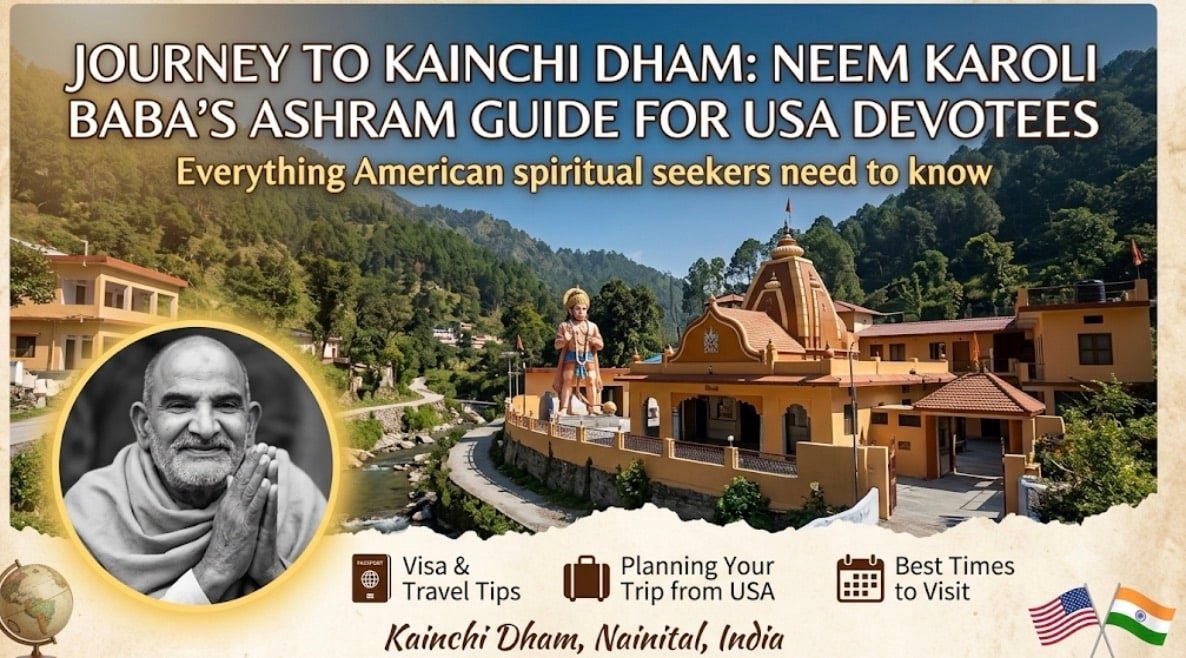
Neem Karoli Baba & Kainchi Dham Ashram: Ultimate 2026 Guide for USA Travelers
In the quiet folds of the Kumaon Himalayas, far from the noise of Silicon Valley boardrooms and the rush of American city life, stands a simple mountain ashram that continues to draw seekers from across the United States. This is Kainchi Dham, the living heart of Neem Karoli Baba’s presence—a place where Western minds first encountered an ancient Indian path of love, service, and radical presence. For many Americans, the name Neem Karoli Baba is no longer just a footnote in spiritual history. It is tied to the inner journeys of Ram Dass, Steve Jobs, Mark Zuckerberg, and countless others who found something life-altering in the presence of this humble Hanuman devotee known simply as Maharaj-ji.
Whether you are planning your first spiritual trip to India, researching Neem Karoli Baba’s connection to American tech leaders, or looking for practical details on how to reach Kainchi Dham from the USA in 2026, this guide offers a complete, human-centered roadmap. We will walk through his life story, the daily rhythm of the ashram, exact travel routes from Delhi, the best seasons for American visitors, stay options, and the enduring USA ashrams that keep his teachings alive on American soil.
- Birth name: Lakshman Narayan Sharma (around 1900–1973)
- Lovingly known as: Neem Karoli Baba, Neeb Karori Baba, Maharaj-ji
- Primary ashram in India: Kainchi Dham (Neem Karoli Ashram), Nainital district, Uttarakhand
- Famous American devotees: Ram Dass, Steve Jobs, Mark Zuckerberg, Krishna Das, Larry Brilliant
- Key USA center: Taos Hanuman Temple (Neem Karoli Baba Ashram), New Mexico
- Core message that reached the West: Love everyone, serve everyone, remember God, and be here now
Who Was Neem Karoli Baba? The Story Behind the Name
Long before his name appeared in Silicon Valley conversations or on the covers of American spiritual bestsellers, Neem Karoli Baba was simply a quiet Indian sadhu whose presence seemed to rearrange the lives of everyone who came near him. Born as Lakshman Narayan Sharma in the village of Akbarpur in Firozabad district, Uttar Pradesh, around the year 1900, he left ordinary life early and wandered as a renunciate. Stories from those years describe a man of few words, deep devotion to Lord Hanuman, and an uncanny ability to see straight into a person’s heart.
People began calling him Neem Karoli Baba after an incident in a small village called Neeb Karori, where local authorities once locked him in a jail cell that mysteriously refused to stay closed. The name stuck, and with it grew a reputation for miracles, fierce compassion, and a teaching style that needed almost no formal philosophy. He did not write books or give long lectures. Instead, he fed people, sat with them in silence, and somehow left them changed.
On 11 September 1973, Maharaj-ji left his physical body in Vrindavan after slipping into a diabetic coma. More than five decades later, his influence has not faded. If anything, it has quietly expanded—especially among Americans searching for meaning beyond achievement and success. His message of simple love, selfless service (seva), and living fully in the present moment continues to travel across oceans, carried by books, kirtan, and personal stories.
The Heart of His Teachings
Neem Karoli Baba’s guidance was never complicated. It boiled down to a few living principles that Western devotees still repeat like mantras:
- Seva – selfless service: Help others without keeping score. Serve food, clean floors, care for the sick—do the work with love and no expectation of return.
- Bhakti – pure devotion: Love God with the whole heart, especially through the form of Hanuman, the embodiment of loyal service and strength.
- Be Here Now: Stop living in the past or future. This simple instruction became the title of Ram Dass’s famous book and a guiding light for an entire generation of American seekers.
- Humility and simplicity: Drop the masks of status, money, and cleverness. Maharaj-ji lived in the most ordinary way possible and expected the same honesty from those around him.
Kainchi Dham: The Mountain Ashram That Changed Western Hearts
Nestled beside the small mountain river Shipra, about 17 kilometers from the popular lake town of Nainital, Kainchi Dham feels both remote and strangely welcoming. The ashram complex sits in the Kumaon region of Uttarakhand, surrounded by forested hills and the kind of quiet that makes city noise feel like a distant memory. Officially established in 1964, the place grew quickly as word spread among Indian devotees and, later, among young Westerners traveling the hippie trail in the late 1960s and early 1970s.
Today Kainchi Dham remains the most visited of Neem Karoli Baba’s Indian ashrams. Thousands of people arrive each year—not for luxury facilities or polished retreat programs, but for darshan, the chance to sit in the presence of the Hanuman temple, and the subtle atmosphere that many describe as still charged with Maharaj-ji’s energy. For American visitors, the journey often feels like closing a circle that began decades earlier with Ram Dass’s books or a casual mention by a tech founder.
Exact Location & Coordinates for Google Maps
Village: Kainchi, Nainital district, Uttarakhand, India
Nearest major town: Nainital (approximately 17 km)
Distance from Bhowali: about 9 km on the Nainital–Almora Road
Approximate GPS coordinates:
Latitude: 29.38° N
Longitude: 79.53° E
Search terms that work well: “Kainchi Dham Nainital,” “Neem Karoli Ashram Kainchi,” or “Kainchi Dham Hanuman Temple.” These coordinates place the ashram firmly in the lower Kumaon Himalayas, reachable by road from Kathgodam, Nainital, and Pantnagar Airport.
Daily Darshan Timings & Ashram Rhythm
The ashram follows a gentle but structured daily schedule that revolves around aarti, darshan, and quiet time for reflection. Timings can shift slightly with the seasons, yet the overall pattern stays consistent throughout the year.
| Activity | Approximate Time |
|---|---|
| Morning Aarti | 06:00 AM – 07:00 AM |
| Morning Bhagvan Darshan | 07:00 AM – 08:00 AM |
| Satsang / Quiet Time | 10:00 AM – 12:00 PM |
| Midday Aarti | 12:00 PM – 01:00 PM |
| Afternoon Darshan | 01:00 PM – 02:00 PM |
| Evening Aarti | 06:00 PM – 07:00 PM |
Entry for darshan is completely free. There is no ticket, no registration desk, and no pressure to donate. The only requirement is respectful behavior: remove shoes where indicated, dress modestly, and keep silence in the main temple areas. Accommodation inside the ashram itself is extremely limited and granted only with prior written permission from the Shri Kainchi Mandir Trust.
How to Reach Kainchi Dham from the United States in 2026
Most American travelers begin their journey in Delhi. From major US cities—New York, San Francisco, Chicago, Los Angeles, or Dallas—there are reliable one-stop or two-stop flights into Indira Gandhi International Airport (DEL). Once you land in Delhi, the remaining distance to Kainchi Dham is roughly 300 kilometers and can be covered by train, private taxi, or a combination of domestic flight and road.
Step 1: Flying into Delhi
Book your international flight with enough buffer time to clear immigration and collect luggage. Many travelers prefer arriving in the morning or early afternoon so they can either rest in Delhi or catch an overnight train the same evening. An Indian e-Tourist Visa is required for US passport holders and should be applied for online well in advance through the official government portal.
Step 2: Delhi to Kathgodam or Nainital
By overnight train (most popular and economical):
- The nearest major railway station is Kathgodam, located about 35–43 km from Kainchi Dham.
- Several comfortable overnight trains run between Delhi and Kathgodam. Journey time is usually 6 to 8 hours.
- From Kathgodam station you can hire a prepaid taxi or shared cab that reaches the ashram in roughly 1 to 1.5 hours.
By private taxi or bus from Delhi:
- A full-day drive from Delhi to Kainchi Dham takes 8 to 10 hours depending on traffic and road conditions.
- Many American visitors prefer hiring a reliable AC cab with a driver who knows the hill routes. This option offers flexibility for rest stops and scenic breaks.
By air plus road:
- The closest airport is Pantnagar (PGH), approximately 65–85 km from the ashram.
- Limited flights operate from Delhi to Pantnagar. From the airport a taxi ride of 2 to 3 hours brings you to Kainchi Dham.
Final Leg: Nainital or Kathgodam to the Ashram
- From Nainital town: about 17 km, 40–50 minutes by taxi.
- From Kathgodam: 35–43 km, 1–1.5 hours.
- Local buses and shared jeeps exist, but a private cab is far more comfortable for first-time visitors carrying luggage.
Best Time to Visit Kainchi Dham for American Travelers
The ashram remains open all year, yet the experience changes dramatically with the seasons. Weather, road conditions, and crowd levels all play a role in choosing the right window.
- March to June (Spring and early Summer): Pleasant daytime temperatures, clear views of the surrounding hills, and ideal conditions for walking and sitting outdoors. This is one of the most popular periods for international visitors.
- September to November (Autumn): After the monsoon clears, the air becomes crisp, the skies turn deep blue, and the ashram feels especially peaceful. Many consider this the sweetest season for longer stays.
- July and August (Monsoon): Heavy rain is common. Landslides can occasionally block roads, and the atmosphere turns misty and inward. Only recommended for those comfortable with unpredictable hill weather.
- December to February (Winter): Cold mornings and nights, sometimes near freezing. Days are often bright and quiet. Fewer crowds mean a more intimate experience, but warm layers are essential.
For most travelers flying from the United States, the windows of April–June and September–November offer the best combination of comfortable weather, reliable transport, and a vibrant yet unhurried spiritual atmosphere.
Staying Near Kainchi Dham: Ashram Rules and Nearby Options
Sleeping inside Kainchi Dham Ashram is possible only with special written permission from the Shri Kainchi Mandir Trust. There is no online booking system, no email confirmation link, and no guarantee of space. Requests are usually made by letter or through a personal introduction from a long-time devotee. Even when permission is granted, stays are typically limited to a maximum of three nights.
Because of these restrictions, the majority of American visitors base themselves in Nainital or the nearby towns of Bhowali and Kathgodam. From these locations a day trip to the ashram is easy and allows you to return to comfortable hotels, guesthouses, or homestays in the evening. Nainital itself offers a wide range of lodging—from simple clean rooms to lakeside resorts—making it a practical hub for first-time visitors.
Neem Karoli Baba’s Deep Roots in American Spiritual Culture
Few Indian teachers of the twentieth century left as quiet yet lasting an imprint on American consciousness as Neem Karoli Baba. His influence traveled not through large public programs but through individual transformation—and those transformed individuals carried the message home.
Ram Dass and the Book That Opened the Door
Richard Alpert, a Harvard psychologist who later became known as Ram Dass, arrived in India in the late 1960s searching for something his academic success could not provide. Meeting Neem Karoli Baba turned his life upside down. The relationship that followed produced the landmark book Be Here Now, which introduced millions of Americans to Maharaj-ji’s simple, direct path. Through Ram Dass’s storytelling, Kainchi Dham and the figure of the barefoot saint entered living rooms and college dorms across the United States.
Steve Jobs and the Photograph That Stayed With Him
In 1974, a young Steve Jobs traveled to India hoping to meet Neem Karoli Baba. By the time he reached the region, Maharaj-ji had already left his body the previous year. Still, the atmosphere of the ashram and the stories of devotees left a permanent mark. Years later, people close to Jobs reported that a photograph of Neem Karoli Baba remained near him during his final days—a quiet testament to the depth of that early encounter.
Mark Zuckerberg’s Visit and Renewed Interest
Decades after Jobs’s journey, Mark Zuckerberg visited Kainchi Dham on the personal recommendation of his mentor. The Facebook founder’s quiet trip with his wife sparked a fresh wave of curiosity among young professionals and entrepreneurs in the United States. Suddenly, conversations about focus, purpose, and inner stillness began to include references to a small Hanuman temple in the Indian hills.
Other American Voices in the Lineage
- Krishna Das – The well-known kirtan singer whose musical path began in the presence of Neem Karoli Baba and continues to fill halls across America with Hanuman chalisa and devotional chanting.
- Dr. Larry Brilliant – The epidemiologist whose work on smallpox eradication was deeply intertwined with his relationship to Maharaj-ji.
- Reports over the years have also linked other tech and business figures, including visits associated with Google and eBay leadership, further weaving the ashram into the cultural fabric of modern American success stories.
Keeping the Flame Alive in the United States: Taos Hanuman Temple
Not every American devotee can make the journey to India. For those who wish to stay connected on home soil, the Taos Hanuman Temple in New Mexico has become a vital center. Located at 416 Geronimo Lane in Taos, this ashram sits at roughly 7,000 feet in the Sangre de Cristo Mountains. Founded in the late 1970s through the inspiration of Ram Dass and other early Western disciples, it holds the distinction of being the first dedicated Hanuman temple in the United States.
The Taos center offers regular kirtan, satsang, community seva projects, and longer retreats. For many Americans it functions as a living bridge—keeping the spirit of Kainchi Dham accessible without the need for an international flight. Visitors often describe the same quality of quiet power and heart-centered simplicity that people report at the original Indian ashram.
Practical Advice for USA Visitors Planning the Trip
- Visa: Apply early for the Indian e-Tourist Visa through the official government website. Processing is usually straightforward for US citizens, but last-minute applications can create unnecessary stress.
- Health preparation: Speak with your doctor about recommended vaccinations and carry a basic medical kit for digestive issues, altitude adjustment, and minor injuries.
- Clothing: Pack modest, loose-fitting clothes suitable for temple visits. Layers are essential because mountain weather can shift quickly from warm sun to cool wind.
- Money: Carry a mix of Indian rupees and international cards. ATMs and card payments work in Nainital, but smaller shops and local taxis often prefer cash.
- Connectivity: Purchase a local SIM card (Jio or Airtel) at the Delhi airport or in any major city for reliable maps and communication.
- Ashram etiquette: Maintain silence in prayer halls, remove footwear where requested, and follow any guidance given by the ashram staff. Photography rules should be respected at all times.
A Realistic 5–7 Day Itinerary for First-Time American Visitors
- Day 1: Arrive in Delhi. Rest, adjust to the time difference, and handle any last-minute travel needs.
- Day 2: Take an overnight train or early private taxi toward Kathgodam or Nainital. Arrive and settle into accommodation.
- Day 3: Morning visit to Kainchi Dham for darshan and quiet time. Afternoon exploring Nainital’s lake, Mall Road, and viewpoints.
- Day 4: Optional second visit to the ashram or a day spent in the surrounding Kumaon hills—Snow View Point, Naina Devi Temple, or local villages.
- Day 5: Begin the return journey to Delhi by train or road, or extend your stay with a short trip to other nearby spiritual sites.
- Days 6–7: Time in Delhi for rest, light sightseeing, or simply absorbing the experience before the long flight home to the United States.
Hanuman Ansh: The 2026 Film Bringing Neem Karoli Baba’s Story to the Big Screen
In 2026, the life of Neem Karoli Baba reached a new generation of seekers through the Hindi biographical film Hanuman Ansh. Directed and written by Vishal Chaturvedi, the movie traces the early years of the young boy Lakshman Narayan as he leaves home after his mother’s death and begins the long inner journey that would one day transform him into Maharaj-ji. The title itself carries deep meaning for devotees—many believe Neem Karoli Baba was an “ansh,” a living fragment or partial incarnation of Lord Hanuman, and the film gently weaves that sacred connection throughout its storytelling.
What makes Hanuman Ansh special is its quiet, heartfelt approach. Instead of relying on heavy special effects or dramatic confrontations, the film moves through simple yet powerful episodes of faith, forgiveness, and seva. It follows the boy’s wanderings across northern India, the moments of grace that shaped him, and the humble beginnings of the presence that later drew seekers from around the world—including the American devotees who would carry his name to the West. Released in August 2026 on a modest budget, the film grew through word of mouth into one of the year’s most unexpected spiritual successes at the box office, resonating with audiences who felt they were sitting in satsang rather than watching a conventional biopic.
For American visitors planning a trip to Kainchi Dham, watching Hanuman Ansh offers a beautiful preparation. It brings to life the same atmosphere of simplicity, love, and Hanuman devotion that still fills the ashram today. The film is planned as the first part of a trilogy, with future chapters expected to explore later periods of Maharaj-ji’s life. Whether experienced in a theatre or later at home, it serves as a moving reminder that the story of Neem Karoli Baba continues to unfold—not only in the hills of Uttarakhand but also on screens across India and beyond.
Those with more time often add a visit to Vrindavan, where Neem Karoli Baba’s samadhi ashram continues to draw devotees, or continue north to Rishikesh for a deeper immersion in the broader spiritual landscape of northern India.
Why Kainchi Dham Still Matters in a Distracted World
In an era when attention is constantly pulled toward screens, metrics, and the next achievement, Kainchi Dham offers something increasingly rare: permission to slow down. The ashram does not promise instant enlightenment or dramatic visions. What it offers is quieter and, for many, more lasting—a return to simple human values of love, service, and presence.
For Americans who first encountered Neem Karoli Baba through the stories of Steve Jobs, the pages of Ram Dass, or the quiet recommendation of a friend, standing in the courtyard of Kainchi Dham can feel like arriving at the source of a long river. The mountains remain, the river Shipra still flows, and the same invitation that transformed so many lives decades ago continues to wait for anyone willing to sit down, be quiet, and listen.
Whether you come for a single morning of darshan or a longer period of reflection, the journey to Kainchi Dham is less about checking a destination off a list and more about remembering what it feels like to be fully here—now.