
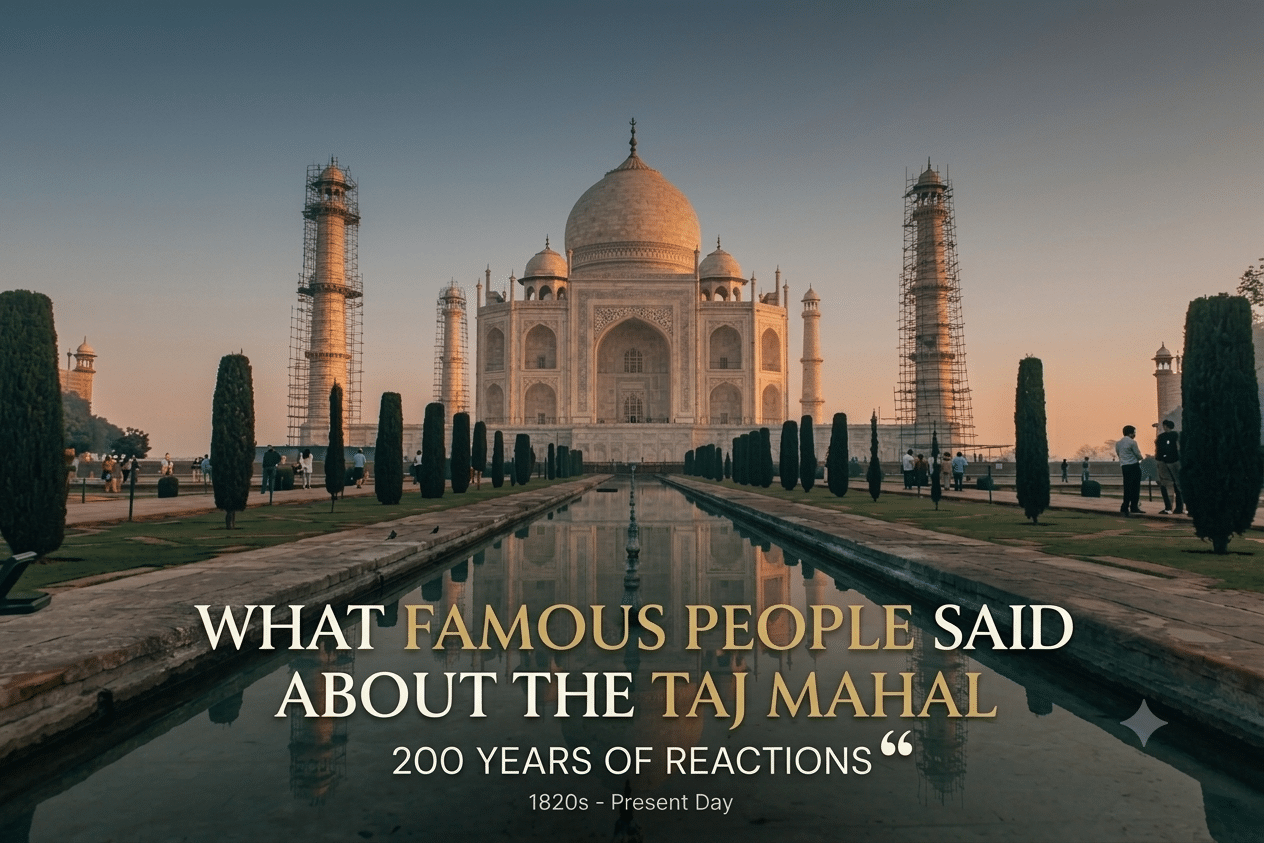
The Taj Mahal Through Their Eyes: 200 Years of Reactions from Politicians, Royals, Writers and Celebrities
For two centuries, emperors, presidents, prime ministers, princes, poets, artists, photographers and celebrities have stood before the Taj Mahal. Some saw a monument of love. Others saw architecture, empire, grief, eternity or something almost impossible to describe.
Few buildings have generated such a long record of human reaction as the Taj Mahal. Since the nineteenth century, visitors have struggled to put its appearance into words. The official Taj Mahal website notes that travellers’ comments themselves became part of the monument’s cultural history.
This is not simply a collection of famous quotations. It is a journey through changing perceptions of the Taj — from British travellers in the early nineteenth century to modern presidents and international celebrities.
1. The Early Nineteenth Century: Awe Before Photography
By the 1820s and 1830s, the Taj Mahal had already become one of the great sights for European travellers in India. Their descriptions are particularly valuable because they capture the monument before modern tourism, mass photography and social media.
The Bishop of Calcutta
Reginald Heber, Anglican Bishop of Calcutta, visited the Taj in January 1825. He had already heard its praises before arriving.
Heber was not completely uncritical: he found some architectural details less appealing than the overall monument. That makes his reaction especially interesting — it was admiration rather than simple flattery.
Source: Official Taj Mahal website, Government of Uttar Pradesh.
Emotional reactions to the monument
Fanny Parks, an English traveller in India, wrote an emotional farewell to the Taj after seeing it. Around the same period, the wife of British officer William Sleeman gave an even more dramatic response.
The statement, recorded by the official Taj Mahal site, shows how the monument could provoke a reaction far beyond architectural criticism: the Taj was being experienced as something connected with death, beauty and eternal memory.
2. Lord Curzon: From Visitor to Restorer
A British Viceroy becomes obsessed with the Taj
Lord Curzon first saw the Taj Mahal in 1887. He later returned to Agra repeatedly after becoming Viceroy of India in 1898 and took a close interest in its restoration.
Curzon’s relationship with the monument was unusual. He was not merely a tourist admiring a famous building. He became involved in its preservation and commissioned a lamp for the tomb chamber.
Source: Official Taj Mahal website, Government of Uttar Pradesh.
3. Mark Twain: The Taj as a Wonder of the World
American writer Mark Twain visited India in 1896. By this time the Taj had become a global icon, but Twain’s writing shows that seeing the building in person could still be startling.
Twain’s account of the Taj is particularly valuable because he observed it at different distances and under different light. Rather than treating it as merely an architectural object, he described the experience of encountering it.
His description helped cement the Taj’s reputation in the English-speaking world as one of the great monuments of human civilization.
4. Rabindranath Tagore: A Tear on the Cheek of Time
The poet transforms architecture into memory
No modern Indian writer is more closely associated with the poetic interpretation of the Taj Mahal than Rabindranath Tagore.
Tagore imagined Shah Jahan’s monument not merely as marble architecture, but as an attempt to preserve human grief against the passage of time.
The image became one of the most enduring literary descriptions of the Taj. The official Taj Mahal website also presents Tagore’s famous interpretation of the monument as a tear on the cheek of time.
Source: Official Taj Mahal website, Government of Uttar Pradesh.
5. Artists Saw Something Almost Unreal
Samuel Bourne — photographer
Samuel Bourne, one of the important photographers of nineteenth-century India, visited the Taj in 1863. He described the building as a dream taking material form — an imagined fantasy transformed into marble.
William Hodges — painter
Hodges’ reaction concentrated on colour and atmosphere: white marble against the blue Indian sky.
Source: Official Taj Mahal website, Government of Uttar Pradesh.
6. President Dwight D. Eisenhower: A Childhood Dream
The twentieth century brought a new class of visitor to Agra: world leaders.
President of the United States
During his 1959 visit to India, U.S. President Dwight D. Eisenhower travelled to Agra with Prime Minister Jawaharlal Nehru and visited the Taj Mahal.
That reaction is particularly revealing. For Eisenhower, the Taj was not simply another stop on a presidential itinerary. It was something he had imagined since childhood.
Source: TIME magazine, December 1959, reporting on Eisenhower’s India visit.
7. Princess Diana: One Photograph Becomes History
In February 1992, Diana, Princess of Wales, visited the Taj Mahal during her trip to India. Her photograph sitting alone on the famous marble bench became one of the defining images associated with the monument in the modern era.
The significance of the visit eventually became larger than the words spoken during it. The image of Diana alone in front of a monument famous as a symbol of marital love acquired a powerful cultural meaning because of what was happening in her own marriage at the time.
Her visit demonstrates another way the Taj generates reactions: sometimes the photograph becomes more famous than the visitor’s words.
8. Bill Clinton: Everyone Loves the Taj
President of the United States
President Bill Clinton visited the Taj Mahal in 2000 with his daughter Chelsea Clinton.
The quotation, reproduced by the official Taj Mahal website, captures something that distinguishes the monument from many other tourist attractions: even people who have never visited it often have a strong mental image of it.
Source: Official Taj Mahal website, Government of Uttar Pradesh.
9. The Taj Becomes a Global Political Stage
By the twenty-first century, visiting the Taj Mahal had become almost obligatory for many visiting heads of state and international dignitaries.
The monument had evolved from an imperial mausoleum into a global symbol of India. Foreign leaders were photographed beside the reflecting pool, on the famous bench, and beneath the great dome.
Among the international political figures associated with visits to the Taj are leaders and members of royal families from the United States, Britain, Canada, Israel, China, Russia and other countries.
10. Donald Trump and Melania Trump: “Inspires Awe”
Donald Trump and Melania Trump at the Taj Mahal, February 24, 2020. Official White House photograph by Andrea Hanks. Source: Wikimedia Commons. Public domain.
President and First Lady of the United States
During his first presidential visit to India, Donald Trump travelled to Agra with First Lady Melania Trump, Ivanka Trump and Jared Kushner.
After touring the monument, Trump and Melania signed the Taj Mahal visitors’ book.
The reaction is notable because it moved beyond the usual language of romance. Trump described the Taj as part of the cultural richness and diversity of India.
Sources: Contemporary reporting by The Indian Express, India Today and Hindustan Times; official White House photograph preserved through Wikimedia Commons.
11. What Makes These Reactions So Different?
Read together, these reactions reveal that the Taj Mahal has never meant exactly one thing to everyone.
- To travellers: it was often almost impossible to describe.
- To artists: it was light, colour, proportion and atmosphere.
- To Lord Curzon: it became a monument requiring preservation.
- To Tagore: it became grief transformed into poetry.
- To Eisenhower: it was a childhood dream finally fulfilled.
- To Diana: one photograph became a symbol far beyond tourism.
- To Bill Clinton: it was a monument whose appeal transcended those who had actually seen it.
- To Donald Trump: it represented the rich and diverse beauty of Indian culture.
12. The Taj Mahal Has Outlived Every Reaction
Perhaps the most extraordinary thing about the Taj Mahal is that every generation thinks it has found a new way to describe it.
The nineteenth-century traveller saw an impossible dream in marble. The poet saw a tear on the face of eternity. The statesman saw a monument of civilization. The photographer saw changing light. The modern president saw a symbol of Indian culture.
Yet the building itself remains almost unchanged in the centre of all these interpretations.
That is why the history of reactions to the Taj Mahal is really a history of how people understand beauty, love, death, memory and power.
Part 2: When Hollywood and Bollywood Met the Taj Mahal
Politicians and royalty are only part of the Taj Mahal’s modern story. Actors, actresses, television personalities and other global celebrities have also travelled to Agra to see the monument. For many, the visit became a memorable photograph; for others, the Taj produced an immediate emotional reaction.
1. Tom Cruise — “I have wanted to come here all my life”
Tom Cruise
Hollywood star Tom Cruise visited the Taj Mahal in Agra on December 3, 2011, during his promotional tour for Mission: Impossible – Ghost Protocol. He was accompanied by his Indian co-star Anil Kapoor.
The visit was especially meaningful to Cruise because he had wanted to see India for many years.
Cruise toured the monument, greeted visitors and posed for photographs with Anil Kapoor. His reaction was less about a promotional appearance and more about fulfilling a long-held personal wish to visit India.
Sources: Associated Press reporting reproduced by India Today; The National; Hindustan Times.
2. Leonardo DiCaprio — A Quiet Visit to the Taj
Leonardo DiCaprio
Leonardo DiCaprio made a remarkably low-key visit to the Taj Mahal in October 2015 while he was in India working on a documentary related to climate change.
Unlike many celebrity visitors, DiCaprio did not arrive with a large public promotional event. Reports described the visit as a quiet or secret trip, with the actor trying to avoid media attention.
The visit itself is well documented, but a reliable, detailed quotation describing his reaction to the monument is difficult to establish. For that reason, this article records the visit without inventing a reaction.
Sources: India Today; The Indian Express, reporting from PTI/Reuters.
3. Will Smith — Excited to See the Taj
Will Smith
Will Smith visited the Taj Mahal in October 2018 during a trip to India that included work connected with Bollywood.
The visit attracted large crowds. According to reporting from Agra officials, Smith was excited to see the monument and happily posed for photographs with visitors and security personnel.
The quote comes from a Taj Mahal security official describing Smith’s interaction with visitors, rather than from Smith himself. It is therefore presented here as an eyewitness description rather than a celebrity quotation.
Sources: The Times of India; The Indian Express.
4. Preity Zinta — “Spellbound” by the Taj
Preity Zinta
Bollywood actress Preity Zinta visited the Taj Mahal with her husband Gene Goodenough and family in May 2016.
What makes her visit particularly useful for this collection is that she personally described her reaction on social media.
The visit was also notable because Zinta had previously worked at the Taj for a film shoot. Even after having seen the monument before, she described the family visit as special.
Source: Hindustan Times, May 13, 2016.
5. Amy Jackson — “One of the most beautiful monuments”
Amy Jackson
British actress Amy Jackson visited Agra during the promotion and music launch of Ekk Deewana Tha in 2011.
According to contemporary reporting, Jackson had never seen the Taj Mahal before. Actor Prateik Babbar explained the monument’s history and significance to her.
The reaction was reported after Jackson learned about the history of Shah Jahan and Mumtaz Mahal. She was described as being taken aback by the story behind the monument.
Source: Hindustan Times, December 29, 2011.
6. Ananya Panday — “Wah Taj”
Ananya Panday
In July 2025, Bollywood actress Ananya Panday shared photographs from her visit to the Taj Mahal.
She later described the experience even more directly, writing that photographs could not fully capture the monument’s beauty and that it had to be seen in person to be believed.
Her reaction is a perfect example of a theme that appears repeatedly throughout the two-century history of Taj Mahal visitors: photographs can record the monument, but many visitors feel that they cannot reproduce the experience of seeing it.
Source: Hindustan Times, July 29, 2025, reporting on Panday’s Instagram posts.
7. Eva Longoria — A “Jumping Photo” in Front of the Taj
Eva Longoria
Actress Eva Longoria visited the Taj Mahal with her fiancé José Antonio Bastón in 2015.
Her reaction illustrates the way social media changed celebrity encounters with the monument. Instead of only leaving a traditional visitor-book message, modern celebrities could instantly share their personal experience with millions of followers.
Source: India Today, December 2015.
8. Julia Roberts — The Taj During Her India Journey
Julia Roberts
Julia Roberts visited the Taj Mahal in 2009 while she was in India during the production of Eat Pray Love.
Her visit connected the Taj with one of Hollywood’s most prominent films associated with travel, spirituality and India during that period.
Contemporary reports document her visit, although a precise, reliable quotation from Roberts about the monument is harder to establish. The responsible approach is therefore to record the visit rather than manufacture a quotation.
Source: India Today, December 2015 retrospective on celebrity Taj Mahal visitors.
9. Ben Kingsley — A Visit from the Actor Who Played Gandhi
Ben Kingsley
British actor Sir Ben Kingsley visited the Taj Mahal with his wife Daniela Lavender in 2009.
Kingsley is particularly interesting in the history of celebrity visits because he is internationally associated with his Academy Award-winning performance as Mahatma Gandhi.
His Taj Mahal visit was reported as part of a wider group of international celebrity visits to the monument. However, this article does not attribute a specific quotation to Kingsley without a sufficiently strong primary source.
Source: India Today retrospective on celebrity visits to the Taj Mahal.
10. Oprah Winfrey — A Television Icon at the Taj
Oprah Winfrey
Oprah Winfrey visited the Taj Mahal in 2012 during her first trip to India for her television programme Oprah’s Next Chapter.
The visit became part of the international media attention surrounding her India journey and placed one of the world’s most recognizable television personalities in front of India’s most recognizable monument.
As with several celebrity visitors in this section, the visit is well documented, but this article avoids attaching an exact Taj Mahal quotation to Winfrey unless the original statement can be verified.
Source: India Today retrospective on celebrity Taj Mahal visitors; contemporary reporting.
11. The Taj Mahal and Bollywood
The relationship between Bollywood and the Taj Mahal is deeper than celebrity tourism. The monument has repeatedly appeared in Indian cinema, music, advertising and popular culture, becoming shorthand for romance and eternal love.
Actors have therefore arrived at the Taj carrying an unusual cultural inheritance: they are not merely tourists seeing a famous monument, but performers who have spent their careers surrounded by the imagery of the Taj.
For Bollywood stars, standing before the monument can feel like stepping into a scene that Indian cinema has been recreating for generations.
12. Why Celebrity Reactions Matter
Celebrity reactions may seem very different from the observations of nineteenth-century travellers, but they reveal an important continuity.
- The traveller wanted to describe something almost impossible to describe.
- The poet turned the Taj into a symbol of time and memory.
- The politician used it as a symbol of culture and diplomacy.
- The actor often encounters it through the language of cinema and romance.
- The modern celebrity shares the experience instantly through social media.
The technology has changed. The photographs have changed. The visitors have changed. But the reaction remains remarkably familiar: people arrive expecting to see the Taj Mahal, and many leave feeling that the real monument is more impressive than the image they carried in their minds.
13. From Presidents to Movie Stars
Across two centuries, the Taj Mahal has hosted an extraordinary range of visitors. Presidents have stood beneath its great dome. Princesses have sat beside its reflecting pool. Writers have tried to capture its meaning in words. Actors have arrived with fans waiting outside the gates. Photographers have chased its changing light.
Yet the monument has remained the common subject of all these reactions.
Perhaps that is the Taj Mahal’s greatest achievement: it allows every generation to see something different while remaining unmistakably the same.